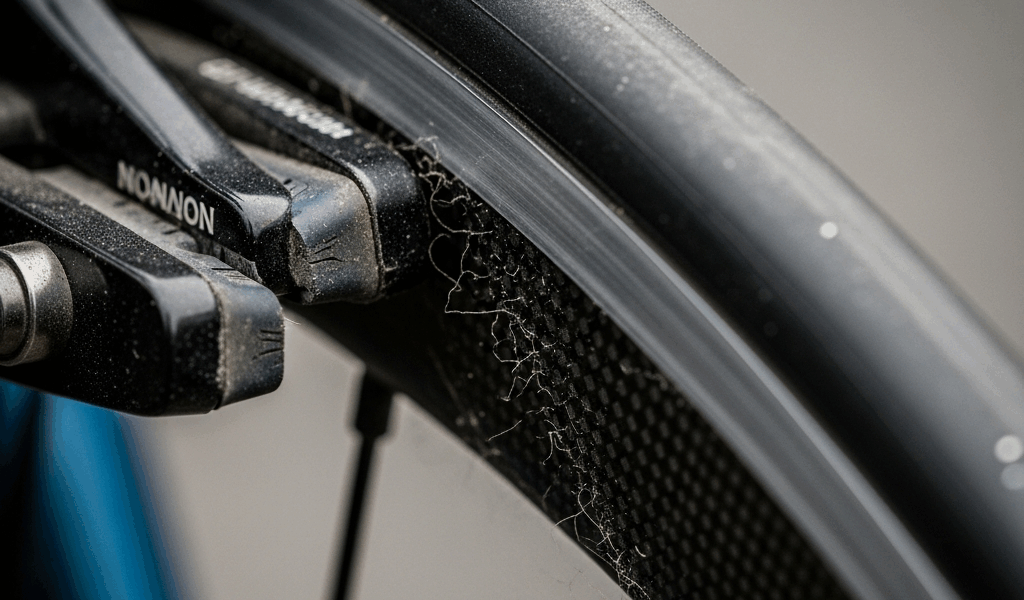
Why Carbon Rims Squeal More Than Aluminum
Carbon rim brake squeal has gotten complicated with all the generic advice flying around. Most of those articles treat carbon braking surfaces like they’re just aluminum painted a different color. They’re not. And that misunderstanding is exactly why riders keep chasing the wrong fixes.
Here’s the actual problem: carbon rims use a resin-based braking surface. That surface heats up faster than aluminum, holds heat longer, and responds to friction in ways aluminum simply doesn’t. Throw in resin buildup, the wrong pad compound, and surface glazing — any one of those three — and you’ve got a vibration nightmare that aluminum riders rarely deal with at the same intensity.
The squeal is almost always fixable. But you need to know which fix matches your specific situation. Randomly swapping pads and hoping for the best? Don’t make my mistake.
Check Your Brake Pads First — Compound Matters
I’m apparently someone who learns things the hard way, and Ultegra aluminum pads on Zipp 303 carbons never worked for me. Three weeks of riding a bike that sounded like a squeaky bath toy before I figured that out. That was 2022. Cost me about $40 in wasted pads and a lot of embarrassment on group rides.
Aluminum-compound pads on carbon rims — that’s the number one cause of squeal. Not an exaggeration. Aluminum pads rely on friction modulation that doesn’t translate to carbon’s resin surface. Worse, they generate enough heat to slowly degrade the braking surface itself. You’re not just dealing with noise — you’re dealing with damage accumulating on every ride.
What you actually need: cork-compound pads or carbon-specific rubber compounds. Kool-Stop and SwissStop are the names you want. Both make formulations designed specifically for carbon braking surfaces. When you’re reading the packaging, look for “carbon rim compatible,” “cork-infused,” or “resin-safe.” If the box doesn’t explicitly say one of those things, assume it’s aluminum-optimized and walk away.
Kool-Stop salmon pads run around $18–24 per set. SwissStop FloodStop cartridge pads sit somewhere in the $22–30 range. That’s not a luxury upgrade — that’s just buying the right tool. So, without further ado, let’s get into the actual fix.
Swapping pads alone solves the squeal roughly 40% of the time, in my experience. Significant. But it also means the other 60% of you need to go deeper.
How to Toe In Your Brake Pads Properly
Toeing in your pads is what separates riders who actually fix brake squeal from riders who just learn to live with it. That’s what makes this technique so endearing to us carbon wheel owners — it costs nothing and works surprisingly well.
Here’s what toeing in actually means: instead of the pad face sitting perfectly flat and parallel against the rim, you angle it so the front edge contacts first while the rear edge maintains a 1–2mm gap. When pads hit carbon flat, they vibrate. That vibration is the squeal. Staggered contact kills the vibration before it starts.
While you won’t need a full tool kit, you will need a handful of basics — a 4mm or 5mm hex key depending on your brake model, and something thin enough to act as a spacer. I use a business card folded twice. Some riders use feeler gauges or an old loyalty card from their wallet. The specific object matters less than the thickness. You’re aiming for about 1.5mm at the rear pad edge.
First, you should loosen your brake caliper’s main mounting bolt by two full turns — at least if you want the caliper to move when you apply pressure. Don’t remove it completely. Next, squeeze the brake lever firmly so both pads contact the rim. Hold that pressure while you loosen the individual pad mounting bolts with your hex key — usually one bolt per pad, though some caliper designs share a bolt between pads.
Now the critical part. Keep brake pressure on. Slip your folded business card between the rear pad and the rim on one side. The front edge of that pad should still be touching the rim solidly — zero gap there. Tighten the pad mounting bolt while the card holds that rear clearance. Repeat on the other side if your setup requires it.
Release the lever, pull the spacers out, and re-tighten the main caliper bolt. Spin the wheel. You want front-edge contact and clean air at the rear. Carbon’s resin surface is unforgiving about vibration — even a 1.5mm gap at the rear completely changes how the pad dampens instead of amplifying frequency noise.
Clean the Rim Braking Surface Before Anything Else
Probably should have opened with this section, honestly. Cleaning gets skipped constantly because riders assume the problem is mechanical — wrong pads, wrong alignment, something broken. Sometimes it’s just contamination.
Carbon braking surfaces collect grime like nothing else I’ve worked with. Chain lube overspray. Sunscreen. Resin dust left over from manufacturing. Road film. All of it layers into a coating that prevents consistent friction and causes squeal even when your pads are correct and your alignment is perfect.
Isopropyl alcohol — 70% concentration works fine, nothing fancy required. Dampen a clean rag, not soaked, and wipe the entire braking surface on both sides. Let it dry for 30 seconds. The carbon should look matte black and feel slightly rough under your fingertip. If it looks shiny or feels slick, wipe again.
Do not use acetone. A shop mechanic in Portland told me about a customer who used acetone on a set of Enve 3.4s and degraded the resin binder badly enough that the wheels needed professional refinishing. That’s a $200+ mistake to save a few minutes. Isopropyl is safe, effective, and costs $3 at any drugstore.
Test your brakes immediately after cleaning. You’d be surprised how often contamination was the entire problem — and how fast you feel the difference.
Still Squealing After All That — What to Check Next
If you’ve swapped to carbon-compatible pads, toed in the alignment, and cleaned the braking surface — and the noise is still there — three less obvious culprits are left worth checking.
The brake caliper pivot bolt might be the best option to check first, as brake squeal requires consistent caliper rigidity. That is because a loose pivot lets the caliper flex sideways under braking pressure, which creates micro-vibrations that feed directly into squeal. Tighten the pivot bolt firmly. This clears up roughly 15% of stubborn cases that survive everything else.
Cable housing flex is next. Old, compressed, or poorly routed brake housing flexes under braking — and that flex moves the caliper in small, noise-generating ways. Grab the housing near the caliper and flex it side to side. Excessive movement means it needs replacement. Twenty minutes with basic tools, maybe $8 in housing from any bike shop. Rarer on newer bikes, but it happens more than people expect.
Finally: glazed pad surfaces. Pad compound gets polished smooth over time — the friction surface literally wears into a mirror finish that reduces bite and increases vibration. Light sanding with 120-grit sandpaper on the pad face usually brings it back. If sanding doesn’t restore it, the pads are done anyway and need replacing regardless.
Here’s the honest version of all this: carbon rim brake squeal almost never requires serious money to fix. Cleaning and toeing in take maybe 15 minutes total. Pad replacement — your biggest potential expense — rarely runs past $30. Work through the sequence above in order, and you’ll find where your problem actually lives.


Stay in the loop
Get the latest cycle tech trends updates delivered to your inbox.