Rouvy vs Zwift — Which Indoor Cycling App Is Worth Your Money?
The Rouvy vs Zwift debate comes up constantly in cycling forums, group rides, and probably your local bike shop’s back room. I’ve spent serious time on both platforms — over two years of winter training blocks, recovery rides, and the occasional 5am sufferfest — and I have opinions. Strong ones. If you’re trying to decide where to spend $15 to $20 a month, this is the breakdown I wish someone had handed me before I ended up paying for both simultaneously for three months like an idiot.
Here’s the short version: these two apps are not really competing for the same rider. They look like they are. They’re both indoor cycling apps, both work with smart trainers, both have structured routes and training plans. But the core experience is fundamentally different, and once you understand that difference, the choice gets a lot easier.
Rouvy vs Zwift — Different Apps for Different Riders
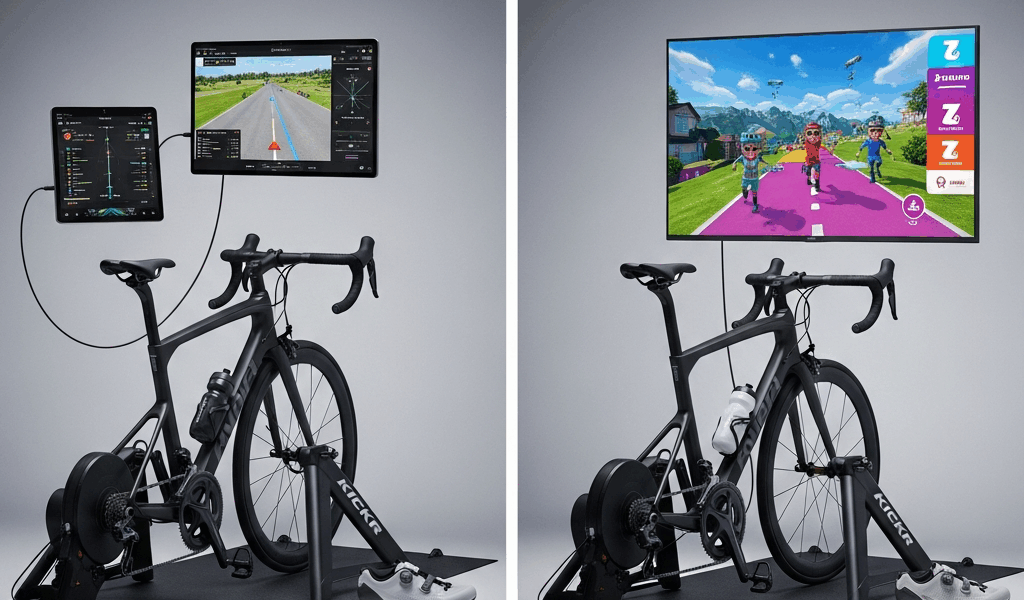
Rouvy is built around real-world routes. You’re watching actual video footage of roads — the Strade Bianche white gravel, the hairpins on Alpe d’Huez, the flat coastal roads of Mallorca — overlaid with augmented reality graphics showing your speed, gradient, and other riders. The video syncs to your effort. Pedal harder on a climb and the footage slows to match. Ease off and it flows. It feels like you’re actually there in a way that a cartoon environment simply cannot replicate.
Zwift is a virtual world. Watopia, the main fictional island, is a lovingly rendered digital landscape with volcanos, underwater tunnels, and a medieval castle you ride past on the way to the sprint segment. Your avatar — which you can dress up, upgrade with in-game drops, and deck out in kit from real cycling brands — rides alongside thousands of other real people logged in at the same time. The social layer is thick. The racing infrastructure is serious. It’s a video game that also happens to make you very fit.
Frustrated by grey skies and a turbo trainer that hadn’t moved in four months, I downloaded Rouvy in November 2022 after seeing a post about its BKOOL merger. I was already a Zwift subscriber. I told myself I’d cancel one after a month. Reader, I did not cancel one after a month.
The philosophy difference matters more than any feature checklist. Rouvy asks: what if indoor riding felt like outdoor riding? Zwift asks: what if indoor riding was its own thing worth doing for its own reasons? Neither answer is wrong. But one of them is your answer.
Features Compared Side by Side
Let me put the practical stuff in one place. Probably should have opened with this section, honestly, because this is what most people are actually looking for.
| Feature | Rouvy | Zwift |
|---|---|---|
| Monthly Price | $14.99 | $19.99 |
| Route Library | 1,500+ real-world video routes | Virtual worlds + some real-world routes |
| Organised Racing | Yes, but limited | Yes — ZRL, WTRL, daily events |
| Group Rides | Available | Extensive — multiple daily |
| Training Plans | Yes, with structured workouts | Yes — including plans from TrainerRoad-style structure |
| Device Compatibility | ANT+, Bluetooth, most smart trainers | ANT+, Bluetooth, most smart trainers |
| Mobile App | iOS and Android | iOS and Android |
| Apple TV Support | Yes | Yes |
| Free Trial | 7 days | 7 days |
| Community Size | Smaller but growing | 4+ million registered users |
Both apps work with all the major smart trainers — Wahoo KICKR Core, Tacx Neo 2T, Elite Direto XR, Saris H3, take your pick. I’ve run Rouvy on a Wahoo KICKR v5 and Zwift on both that and a Tacx Flux S, and trainer compatibility has never been the issue on either platform. The pairing process is straightforward on both. That’s not a differentiator.
Price is a real differentiator. Five dollars a month might not sound like much, but that’s $60 a year. Over two years, that’s $120. For some setups, that’s a decent pair of bib shorts.
Where Rouvy Wins
Real Roads, Real Feel
Riding the Col du Tourmalet on Rouvy is genuinely moving in a way that riding a virtual cartoon mountain is not. The video footage — professionally shot, well-lit, synced to your cadence and power — puts you on the actual road. You see the actual tarmac, the actual gradient changes, the actual view from the top. My partner, who is not a cyclist and has no patience for my indoor training setup, wandered past during a Rouvy session and said it looked like I was actually somewhere. She has never said that about Zwift. Make of that what you will.
The augmented reality overlay shows your ghost (your previous best effort on that route), other riders as AR avatars, and your standard metrics. It’s clean. It doesn’t overwhelm the video. The result is something that feels more like a training tool than a game, which is exactly what certain riders want.
The BKOOL Merger — More Routes Than Ever
Drawn in by the route expansion following Rouvy’s merger with BKOOL, I went back and retested the platform in late 2023, and the route library had genuinely grown. BKOOL contributed a significant catalog of Spanish and European routes, and the combined library now sits north of 1,500 real-world video routes. That covers the Tour de France stages, the major classics, iconic climbs across Europe, routes in the US, Japan, South America. If you’ve ever wanted to mentally teleport to a specific piece of road while suffering on a trainer, Rouvy has probably filmed it.
Price
At $14.99 per month, Rouvy is five dollars cheaper than Zwift’s $19.99. That’s the straightforward version. The deeper point is that Rouvy delivers more per dollar for a specific type of rider — someone who trains alone, values realism, and doesn’t particularly care about virtual jerseys or Zwift racing leagues. For that rider, paying more for Zwift would be paying for features they’ll never use.
Lower Hardware Floor
Rouvy’s video-based format is less graphically demanding than Zwift’s rendered 3D world. It runs more smoothly on older or lower-powered hardware. If you’re running it on an older iPad or a budget Android tablet, Rouvy is going to give you a better experience than Zwift, which can look rough at lower graphics settings and benefits noticeably from more powerful machines.
Where Zwift Wins
The Community Is Not Even Close
Zwift has over four million registered users. At any given time — I’ve checked at 6am, at noon, at 11pm — there are thousands of people riding in Watopia. There are always group rides happening. There are always races. The Zwift Racing League runs structured seasons with team results. WTRL (World Tactical Racing League) hosts events that feel genuinely competitive. The community that has built up around Zwift has no equivalent on Rouvy, and that matters enormously if you’re motivated by riding with other people.
I’ve made actual friends through Zwift. Real ones. I met a guy from the Netherlands at a Tuesday night group ride, we started messaging, and we’ve now ridden together in person twice — once in Yorkshire and once in Girona. That sounds improbable until you understand how genuinely social Zwift is at its core. The ride-on system, the companion app, the ability to text other riders mid-effort — it creates connection in a way that a video playing on your screen simply cannot.
Racing Infrastructure
Zwift racing is its own thing. ZwiftPower (now integrated directly into the platform) handles results, categorization, and anti-sandbagging monitoring. There are A through D categories based on w/kg. There are specialty categories for crit racing, climbing, sprint-heavy circuits. Race organizers run events daily across time zones. If you want to pin a number on and go hard against real people with real results, Zwift is the only indoor platform doing this at scale.
My best Zwift memory is finishing third in a C-category race on the Watopia Volcano Circuit after spending the last two minutes buried in a breakaway group of four. The finish line sprint was real. The burning legs were real. The third place was real. Rouvy’s group rides don’t replicate that.
The Gamification Layer
Zwift drops — the in-game currency earned through riding — let you unlock new kit, bikes, and wheels. Some of this has actual performance impact in the game. The Tron bike (earned through completing the Everest challenge — climbing 50,000m of elevation, which is exactly as painful as it sounds) is faster in certain conditions. This is either motivating or annoying depending on your personality type. For me, it was motivating. I rode extra hours specifically to unlock stuff. That’s good product design, whatever you think of it philosophically.
World Variety
Beyond Watopia, Zwift offers Makuri Islands, New York, London, Richmond, Innsbruck, Yorkshire, and France. Each has distinct terrain and feel. London’s Box Hill is a genuine lung-burner. Yorkshire’s circuits replicate the 2019 World Championship course. The variety of virtual terrain, combined with a rotation schedule that changes which worlds are accessible each day, keeps things fresh in a way that takes deliberate effort from Rouvy’s route library to match.
Which Should You Choose?
Here’s where I’ll give you a straight answer rather than hedging in every direction.
Choose Rouvy if you are primarily a solo rider who trains with purpose, finds real-world visuals motivating, and values a lower subscription cost. If the thought of pedaling past a cartoon castle leaves you cold but riding the actual road up Mont Ventoux appeals to something real in you, Rouvy is your platform. It’s especially good for riders preparing for specific events or routes — the ability to pre-ride a real course on your trainer before you fly there to race it is genuinely valuable.
Choose Zwift if you need other people to push you, if racing appeals to you, if you find gamification motivating rather than gimmicky, and if you want your indoor sessions to feel like events rather than solitary training blocks. The $5 monthly premium over Rouvy buys you access to one of the best online sports communities in existence. That’s a fair trade for the rider who will actually use it.
There’s also a third option that I took for longer than I should have — run both. Rouvy for weekday training rides where I wanted to focus on real-route specificity. Zwift for weekend group rides and races where I wanted company. It cost me about $35 a month and it was worth it for a while. But if I had to pick one today, right now, I’d go Zwift. I’m motivated by competition and community in a way that no amount of gorgeous real-world video footage quite replaces.
The lesson I probably learned too late — and that you can learn right now for free — is that the best indoor cycling app is the one that actually gets you on the trainer on the days you don’t feel like it. For some riders, that’s the goal on Alpe d’Huez appearing on their screen. For others, it’s the knowledge that forty people are waiting at the start pen and the race goes off in three minutes whether you’re clipped in or not. Know which rider you are, and the answer is easy.



Stay in the loop
Get the latest cycle tech trends updates delivered to your inbox.