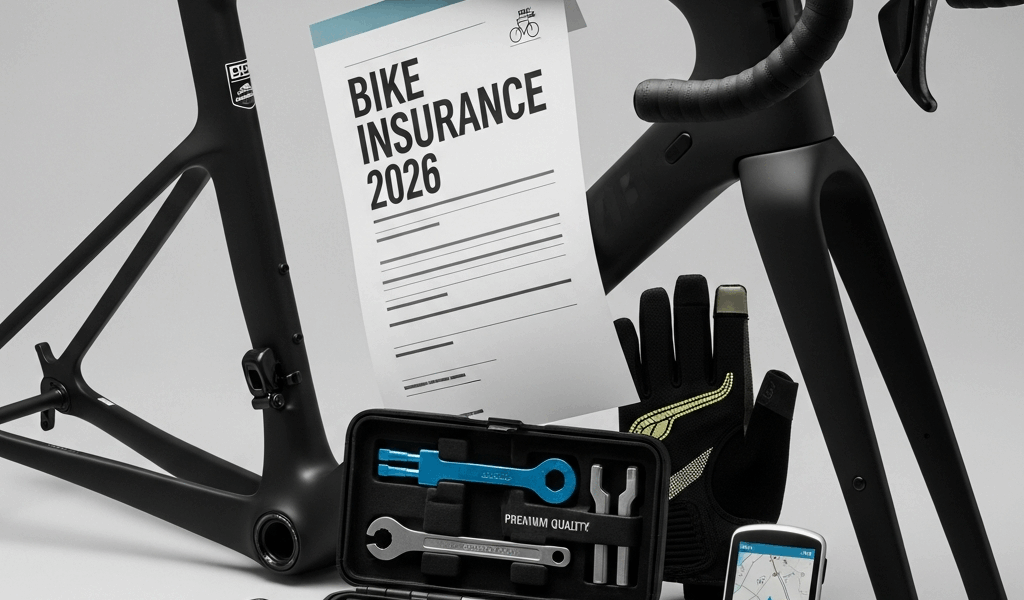
Best Bike Insurance in 2026 — What Cyclists Actually Need
Bike insurance has gotten complicated with all the fine print, coverage gaps, and conflicting advice flying around. As someone who got their Trek Émonda stolen in 2022, I learned everything there is to know about bicycle insurance the hard way. Someone cut my lock with bolt cutters — a Tuesday night, bike chained outside a restaurant on Clement Street, gone by the time I walked out. I had homeowners insurance. I assumed that meant I was covered. The deductible was $1,500. The bike was worth $2,200. I got a check for $700 after two months of back-and-forth — and that was before the adjuster started talking about depreciation. Don’t make my mistake. This guide is what I wish I’d had before any of that happened.
Do You Actually Need Bike Insurance?
Probably should have opened with this section, honestly — because the answer genuinely depends on the numbers, and most cyclists never sit down and do the math.
The core question is whether your homeowners or renters insurance already covers your bike. Often, yes — in theory. Most standard HO-3 policies cover personal property, bicycles included, for theft and certain damage types. Your bike falls under personal property up to whatever sublimit your policy sets, which on a typical Allstate or State Farm policy lands somewhere between 10% and 70% of your total personal property coverage. Sounds reasonable until two specific things enter the picture: deductibles and actual cash value.
The Deductible Problem
The average homeowners deductible in the U.S. runs somewhere between $1,000 and $2,500 right now. If your bike is worth $1,800 and your deductible is $1,500, you’re filing a claim for $300. Except you’re also flagging your homeowners record — which can bump your premium at renewal. The math almost never works for mid-range bikes under homeowners coverage. A $400 bike? Skip the separate policy entirely. A $3,000 bike? Gray zone. A $6,000 to $12,000 carbon road bike or a full-suspension enduro rig? Get dedicated coverage. Full stop.
Actual Cash Value vs. Replacement Cost
But what is actual cash value? In essence, it’s what your bike is worth today — not what it costs to replace it. But it’s much more than that distinction on paper. Standard homeowners policies pay ACV, and bikes depreciate fast. A Specialized S-Works Tarmac SL7 you bought for $9,000 two years ago might get valued at $5,500 under ACV methodology. Dedicated bike insurance policies typically offer agreed value or replacement cost coverage instead. That difference alone is worth hundreds of dollars on a real claim — and it’s the primary reason standalone bike policies exist at all.
When Homeowners Coverage Is Enough
If your bike cost under $1,500, your homeowners deductible is below $500, and you keep the bike inside your home, homeowners coverage is probably fine. Add a scheduled personal property endorsement — most insurers offer it for $15 to $30 per year — and you remove the deductible entirely for that item. I did this for my backup commuter, a 2019 Cannondale Quick 4, for $18 annually. For that bike, that’s absolutely the right call.
What Good Bike Insurance Covers
Dedicated bike insurance bundles coverage types that home policies either exclude outright or handle badly. Here’s what to actually look for — and what the fine print quietly takes away.
Theft Coverage
The obvious one. A solid policy covers theft whether your bike is at home, locked outside a coffee shop, sitting in your car, or staged at a race venue. Read the lock requirement language carefully — some policies require a U-lock rated to a specific security level, with Sold Secure Gold as the common benchmark. Use a lesser lock and they can deny the claim outright. Velosurance specifies in their policy documents that the bike must be secured to a fixed immovable object with a lock rated Sold Secure Silver or above. Not an unreasonable ask, but it’s a real requirement that will matter at claim time.
Crash Damage
This is where dedicated policies completely separate themselves from homeowners. Homeowners covers theft and certain named perils — fire, vandalism — but crashing your own bike? Your problem. A carbon frame that picks up a dent or crack in a fall is entirely on you under a standard homeowners policy. Under Velosurance, Markel, or Spoke, that same crash is a covered event. Carbon repair or full replacement runs $1,200 to $4,000-plus for a quality frameset — that coverage category alone justifies standalone insurance for anyone riding carbon.
Liability Coverage
Underrated. Completely overlooked. If you hit a pedestrian, a dog, another cyclist, or a car — and cause injury or property damage — you can be sued. Your homeowners liability clause may extend to cycling incidents, but that varies widely by policy and state. Dedicated bike policies include third-party liability as an add-on, typically in $100,000 to $500,000 increments. If you ride in cities, group rides, or cyclocross — anywhere the density of other humans is high — liability coverage isn’t optional. It’s also cheap: usually $20 to $40 per year added onto a base policy.
Race and Event Coverage
Most standard policies — homeowners and many entry-level bike policies — exclude racing entirely. A crash during a criterium, gran fondo, or XC race is an uncovered event by default. Velosurance and Markel both offer race coverage as an endorsement. Spoke includes amateur racing in their base policy up to certain event categories. If you pin a number even twice a year, check whether your policy has a racing exclusion. I found mine did — buried in the exclusions on page 14 of a 22-page document — after a friend went down in a Cat 4 crit and his insurer denied the claim without blinking.
What Policies Typically Exclude
- Normal wear and tear — tires, cables, brake pads, chain wear
- Mechanical breakdown not caused by a specific incident
- Cosmetic damage like scratches or paint chips without structural impact
- E-bike motors in some policies — check the motor wattage limits explicitly
- Bikes used for commercial delivery or hire
- Theft without a police report filed within 24 to 72 hours
Best Bike Insurance Options Compared
Frustrated by my own lack of research before that Émonda claim, I spent about three weeks in early 2025 pulling actual quotes and reading full policy documents for every major option — coffee going cold, highlighter in hand, policy PDFs open across two monitors. Here’s what I found across two realistic bike values: a $3,000 mid-range bike and an $8,000 high-end build.
Velosurance
Velosurance might be the best option for most serious cyclists, as dedicated bike coverage requires genuinely bike-literate underwriting. That is because their coverage language was written by people who actually understand bikes — you can insure a 750-watt e-bike, a cargo bike, a BMX setup, or a $15,000 Pinarello without someone asking why your bicycle costs more than a used Honda.
For a $3,000 bike with full replacement cost coverage, theft, crash damage, and $100,000 liability, quotes in 2025 ran between $120 and $160 per year depending on zip code and storage situation. For an $8,000 bike with the same coverage, expect $280 to $360 annually. Race coverage adds roughly $30 to $60 per year on top of that. The claims process has a strong reputation in the cycling community — r/cycling and several dedicated cycling forums have extensive threads of positive claims experiences going back years, which apparently matters more than any marketing copy.
Markel Insurance
Markel is an established specialty insurer — not cycling-specific, but they’ve offered bicycle coverage for decades and their policies hold up. Their base coverage is competitive, and they’re particularly strong if you want to insure multiple bikes on a single policy. Household fleet coverage is handled cleanly here.
For a $3,000 bike, Markel came in around $100 to $140 per year. For an $8,000 bike, roughly $240 to $320. Their racing exclusion is more restrictive than Velosurance’s by default — sanctioned USAC races require a specific endorsement that adds cost. Customer service response times have been slower in my experience, but the coverage language is clear and claims generally get honored without excessive friction. That’s what makes Markel endearing to us multi-bike households: clean fleet handling, no fuss.
Spoke (Formerly Known as Sundays Insurance)
Spoke launched as a direct-to-consumer cycling insurance app — the modern, frictionless take on the category. The interface is genuinely excellent. Getting a quote takes about four minutes. They include amateur racing coverage in their base policy, which is a real differentiator that saves you the endorsement conversation entirely.
For a $3,000 bike, Spoke quotes came in at $130 to $170. For an $8,000 bike, $290 to $380 — slightly higher than the others in some configurations, but the racing inclusion and app-based claims process (submit photos directly, no paper forms) makes it worth considering if you race regularly. Spoke is newer, though. Less claims history to evaluate. Worth acknowledging.
Homeowners Scheduled Personal Property Rider
For bikes under $2,500, this remains the most cost-effective move. Call your existing insurer, ask to schedule your bicycle as personal property, provide a receipt or appraisal, and pay $15 to $40 per year for no-deductible theft coverage. It won’t cover crash damage. It won’t cover racing. But for a commuter or casual weekend bike, it’s genuinely sufficient — and you don’t need a new insurer, a new policy, or a new login to manage.
Quick Comparison Summary
- $3,000 bike, full coverage: Markel (~$120/yr) < Velosurance (~$140/yr) < Spoke (~$150/yr)
- $8,000 bike, full coverage: Markel (~$280/yr) < Velosurance (~$320/yr) < Spoke (~$335/yr)
- Best for racing coverage: Spoke (included base) or Velosurance (endorsed)
- Best for multiple bikes: Markel or Velosurance
- Best for simplicity and app experience: Spoke
How to Lower Your Bike Insurance Cost
Stunned by how straightforward the discounts actually are once you know what insurers respond to, I started asking underwriters directly what factors genuinely move premiums. Not the marketing page answers — the real ones. Here’s what works.
GPS Trackers — The Single Biggest Factor
Installing a GPS tracker is probably the most impactful thing you can do for both recovery odds and insurance premiums. Velosurance offers a documented discount for bikes with Apple AirTag, Tile, or dedicated cycling trackers like the Sherlock GPS or Invoxia Bike Tracker installed. The Sherlock mounts inside a standard 31.8mm or 35mm handlebar — essentially invisible once it’s in there. It runs $119 upfront plus $4.99 per month for cellular tracking.
From an insurer’s perspective: a tracked bike is a recoverable bike, which means lower probability of a total-loss theft claim. Markel’s underwriters confirmed they factor GPS installation into individual quotes when disclosed upfront. Disclose it. Annual premium savings can offset the tracker’s subscription cost in the first year alone.
Secure Storage Documentation
Insurers reduce risk ratings when you can demonstrate secure storage. A locked garage beats a shed. A dedicated bike storage room with a deadbolt beats a garage. A storage cage in an apartment building with security cameras beats a hallway. Photograph your setup, note the specific lock hardware — a Kryptonite New York Fahgettaboudit Chain with a Disc Lock is a categorically different thing than a $12 cable lock — and disclose all of it during the quote process. Accurate disclosure also protects your claim if you ever actually need to file one.
Club Memberships and Associations
USA Cycling membership, League of American Bicyclists membership, and recognized local cycling club affiliations can unlock association discounts with several insurers. Velosurance has historically offered discounts to USA Cycling members — membership itself runs $25 to $85 per year depending on license category. If it drops your annual premium by $20 to $40, it’s a wash at worst and essentially free money at best, particularly since a USA Cycling license also provides some event liability coverage as a member benefit anyway.
Higher Deductibles on High-Value Bikes
Counterintuitive for anyone who got burned by a high deductible before — but on an $8,000-plus bike, accepting a $250 or $500 deductible instead of $0 can reduce annual premiums by 15% to 25%. Run the five-year numbers. Go five years without a claim — statistically likely even for active cyclists — and you’ve saved $150 to $400 in premiums. File one claim, the deductible costs you $250 to $500. Expected value favors the deductible option for bikes in the $6,000 to $10,000 range when stored securely.
Annual Payment vs. Monthly
Every insurer I quoted offered a discount for paying annually instead of monthly. Discounts ranged from 4% to 8% — not transformative, but genuinely free savings for anyone who can handle the upfront cost. On a $320 annual premium, that’s $13 to $26 back for doing nothing except paying once instead of twelve times.
Bundling Considerations
Some homeowners insurers will discount a bike policy endorsement if you already hold a home and auto policy with them. Ask — explicitly. It’s not advertised. My State Farm agent volunteered nothing about scheduled property discounts until I asked the direct question, at which point it took four minutes to add my road bike to my existing policy for $22 per year with no deductible for theft. I left that conversation frustrated it hadn’t come up sooner. Probably should have pushed earlier, honestly. But $22 annually felt like a reasonable outcome either way.
First, you should figure out your bike’s actual replacement value — at least if you haven’t looked at current market prices recently, because depreciation cuts both ways and you might be over- or under-insuring. The bottom line: best bike insurance for your situation depends on your bike’s value, how you ride, where you store it, and whether you race. For anything over $2,500, dedicated standalone coverage from Velosurance, Markel, or Spoke beats homeowners alone — especially once crash damage enters the equation. Do the math before an incident forces you to do it for you.


Stay in the loop
Get the latest cycle tech trends updates delivered to your inbox.