How to Tell If Your Derailleur Hanger Is Bent
Rear derailleur troubleshooting has gotten complicated with all the conflicting advice flying around. As someone who’s destroyed a hanger on a gravel ride and then spent 45 minutes blaming the wrong part, I learned everything there is to know about diagnosing this problem the hard way. Today, I will share it all with you.
The three visual signs are unmistakable — at least once you’ve seen them once.
First: chain skipping mid-cassette without any cable slack. You’re pedaling hard, shift up two cogs, and the chain slips on a tooth that normally tracks clean. Cable tension is fine. The cage moves when you hit the barrel adjuster. But the shift feels lazy. Incomplete. That’s the cage sitting at a slight angle to the cassette plane — throwing off tooth engagement timing in a way that’s maddeningly subtle.
Second: the derailleur cage looks cocked away from the wheel. Stop pedaling. Get directly behind the bike and look. The cage should run parallel to the cassette. If it’s angling inward toward the frame or outward away from it, you’ve got a hanger problem. A bent hanger rotates the whole derailleur assembly out of plane. Simple as that.
Third: shifting gets progressively worse, not suddenly worse. This is what most people miss. A snapped cable or a limit screw gone wrong causes immediate, obvious failure — you know instantly. A bent hanger causes creeping degradation. Today it’s a hesitation on the 5th cog. Next week you’re dropping the chain on climbs. That slow slide toward misery is the tell.
Probably should have opened with this section, honestly. Before assuming the hanger is bent, rule out the easy stuff first. Check the cable for fraying near the derailleur entry point. Spin the barrel adjuster counterclockwise a quarter turn — sometimes that’s genuinely all it takes. Then verify limit screws. But if those checks pass and the symptoms stick around, the hanger is almost certainly your culprit.
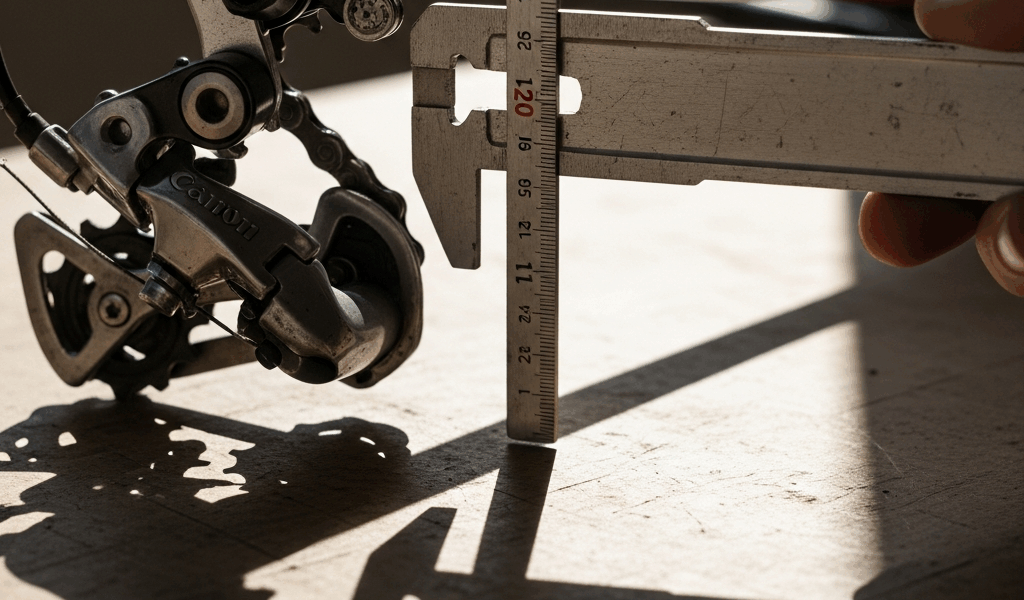
The string or ruler field check. This works roadside or at home. Remove the rear wheel. Hold a straight edge — a 12-inch ruler, a spoke, a taut piece of paracord — vertically against the upper pulley. Rotate the crank backward through a full revolution. That straight edge should maintain contact with the pulley the whole time. A gap anywhere, or the pulley drifting away from the line as you rotate, means the hanger is bent. Not lab-precise, but fast and honest.
What You Need to Straighten a Bent Hanger
But what is a hanger alignment gauge, really? In essence, it’s a reference arm that mounts to your hanger and tells you exactly how far out of plane the derailleur is sitting. But it’s much more than that — it’s what separates a real fix from an educated guess.
The Park Tool DAG-2.2 is the gold standard. Costs around $60 at most shops, lasts essentially forever, and gives you proper precision. I’m apparently someone who buys tools once and keeps them for a decade, and the DAG-2.2 works for me while cheaper no-name gauges never gave me consistent readings.
That said, most riders don’t own one — and you don’t need to spend $60 to fix this.
Budget alignment gauges from Feedback Sports or Wheels Manufacturing run $15 to $25. You mount them on the hanger, they show you the bend direction and rough magnitude, and you straighten from there. Not as precise as the Park tool, but completely honest and practical for home use. That’s what makes them endearing to us shade-tree mechanics.
Many bike shops will check hanger alignment for free, or charge $5 to $10 if you’re not buying anything else. If you’re uncertain about the diagnosis, that phone call is worth making before you start bending metal on a $400 derailleur.
A replacement hanger itself runs $10 to $25 depending on your specific frame. Buy a spare now — especially if this is a bike you ride hard. Your hanger is frame-specific. Not universal. Search the Derailleur Hangers database or Wheels Manufacturing’s cross-reference tool using your frame brand and model number. Then keep that spare in your gear bag. Don’t make my mistake of needing one on a Sunday when every shop is closed.
Step-by-Step How to Straighten the Hanger
Remove the rear wheel completely. Shift the derailleur to its highest gear — the smallest cog — using the barrel adjuster before pulling the wheel. This gives you clearance and takes tension off the hanger while you work.
Mount your alignment gauge on the hanger per its instructions. Most attach to the derailleur’s mounting bolt or rest against the hanger’s trailing edge. The gauge gives you a baseline reading. Write it down if you want — seriously, just jot it on your hand.
Rotate the crank backward slowly and watch the gauge through a full rotation. Check alignment at 12 o’clock, 3 o’clock, 6 o’clock, and 9 o’clock. A bent hanger shows different readings at different positions. The direction of greatest deviation tells you which way the hanger has twisted.
Apply gentle corrective pressure using an adjustable wrench or hanger-specific bending tool. Small adjustments only. Quarter-turn corrections. Overcorrection is the most common DIY mistake — I’ve done it myself more than once. You push too far, then bend back the other way, and the aluminum fatigues faster each time you do it.
Recheck after every single adjustment. Rotate, measure, adjust, measure again. It takes time. It’s boring. It’s exactly how you get it right without destroying the hanger in the process.
One honest note here: aluminum hangers can only be straightened a limited number of times before fatigue cracking becomes a real risk. Steel hangers are more forgiving. After 2 or 3 corrections on the same aluminum hanger, you’re genuinely pushing your luck. If you keep finding yourself bending the same hanger back repeatedly, just replace it. That’s what they’re designed for.
When to Replace Instead of Straighten
There are clear go-or-no-go criteria here. So, without further ado, let’s dive in.
Replace if you see visible cracks. Micro-fractures in aluminum or steel mean structural integrity is already gone. Straightening a cracked hanger accomplishes nothing useful.
Replace if the hanger won’t hold alignment. You straighten it, recheck after two rides, and it’s bent again. The metal has fatigued or the attachment points are stripped. Replacement is faster than chasing that problem in circles.
Replace if the bend was severe enough to damage the derailleur cage itself. Deformed cage plates, loose pulley bolts, bent pulley axles — a straightened hanger won’t fix any of that. You’ll be replacing both pieces anyway, so start with the hanger and assess the cage separately.
Identifying your specific hanger model: use the Derailleur Hangers database or Wheels Manufacturing’s cross-reference tool. Search by frame brand and model year. Hangers are frame-specific — you cannot order a “universal” rear derailleur hanger and expect it to fit. That was true in 2005 and it’s still true now.
After the Fix — Dial In Your Shifting
Once the hanger is back in spec, you’re not quite done. The derailleur almost always needs fine-tuning afterward.
Reinstall the wheel. Spin the crank and shift through the entire cassette slowly — all 11 or 12 cogs, one at a time. Watch the chain track across each one. If it skips or hesitates anywhere, reach for the barrel adjuster on the shift cable. Counterclockwise a quarter turn adds cable tension and helps the derailleur move inward. Clockwise reduces tension if it’s sluggish moving outward.
Check the B-tension screw — the one setting the gap between the upper pulley and the largest cog. It rarely needs adjustment after a hanger fix unless the derailleur took a serious impact. One full turn of that screw moves clearance roughly 1 to 1.5 mm. Leave it alone unless you’re hearing chain rub on the big cog.
Limit screws almost never need touching after a hanger fix unless the cage itself was bent. Adjusting them out of habit is how you create new problems from scratch.
Realistic expectation: shifting should return to normal within a few pedal strokes if the fix was done correctly. Still fighting it after that? The hanger isn’t fully straight, or there’s a secondary problem hiding somewhere. Go back to step one and measure again. That’s not failure — that’s just how bike mechanics actually works.




Stay in the loop
Get the latest cycle tech trends updates delivered to your inbox.