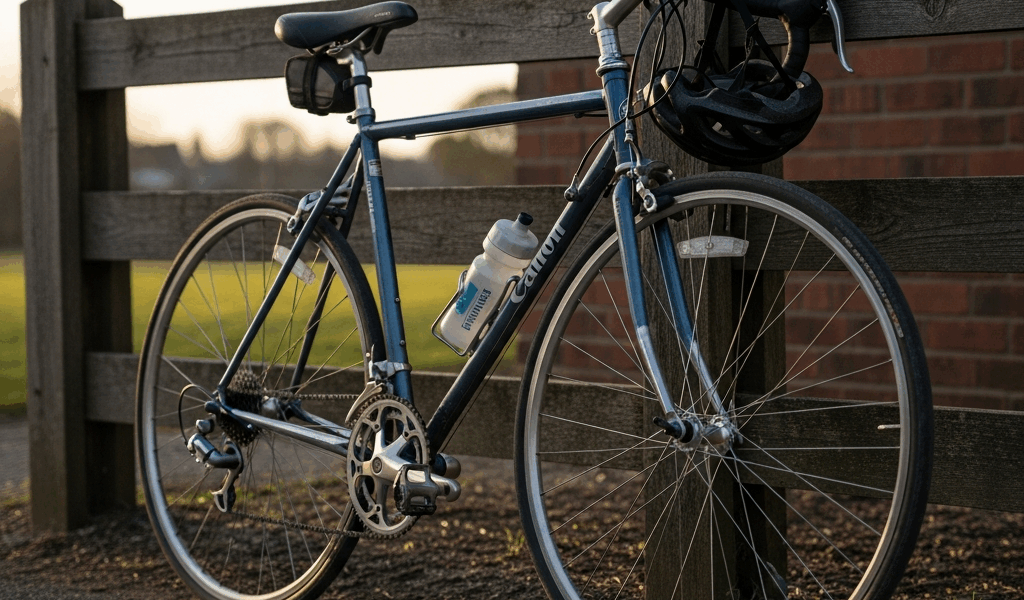
Road Bikes for Beginners — What to Look for Without Overspending
Road biking has gotten complicated with all the gear-snob noise flying around. Walk into any cycling forum and you’ll find someone telling you that anything under $2,000 is basically a death trap, and someone else insisting a $200 Walmart special is all you need. As someone who’s been riding road bikes for fourteen years, I learned everything there is to know about what actually matters — and what’s just marketing dressed up as advice. I’ve watched friends blow money at every price point on bikes that didn’t fit, didn’t last, or just didn’t make sense for where they were as riders. This is my attempt to give you the real version.
Don’t make my mistake. My first road bike was a $349 Schwinn from a big-box sporting goods store — forest green, weighed about 28 pounds, shifters that felt like dragging wet cardboard through mud. Gone within eight months. Roughly $350 I’ll never see again. The good news is that mistake doesn’t have to be yours.
This article includes affiliate links. We may earn a commission at no extra cost to you.
What a Beginner Actually Needs in a Road Bike
Probably should have opened with this section, honestly — because everything else in this guide hinges on it. The marketing departments want you focused on carbon fiber and electronic groupsets. Here’s what actually matters: fit. More than the groupset. More than the frame material. More than whatever name is painted on the downtube. A bike that fits you poorly will hurt within thirty minutes, perform worse than it should, and eventually become an expensive garage ornament. A modest aluminum frame with entry-level components that fits — that bike will bring you joy for years. That’s what makes a well-fitted entry-level bike endearing to us riders who’ve been around long enough to know.
Frame Size — Get This Right First
Road bike sizing runs in centimeters — 49cm, 52cm, 54cm, 56cm, 58cm being the most common. The number refers roughly to the seat tube length, though brands measure slightly differently from one another. A loose starting point: 5’4″ to 5’7″ puts you around a 52cm or 54cm. 5’8″ to 5’11” points toward a 54cm or 56cm. Over 6’0″, start at 56cm. But these are rough guides — genuinely rough. The real test is sitting on the actual bike.
Saddle height, reach to the bars, the angle your back holds while riding — these aren’t abstract concerns. A frame that’s too long in the reach will wreck your lower back inside half an hour. Too short, and you’ll feel cramped, your knees might track inward, your power output drops. Visit a local bike shop even if you’re planning to buy online or used. Most shops will let you sit on a few bikes for free. That information alone is worth the trip.
Groupset — Entry Level Is Fine
The groupset is the collection of parts that handle shifting and braking — derailleurs, shifters, brakes, crankset. Shimano, SRAM, and Campagnolo are the three major players. For a beginner, you’re almost certainly looking at Shimano, and specifically Claris (8-speed), Sora (9-speed), or Tiagra (10-speed).
Shimano Claris gets dismissed by cycling snobs. Ignore them. Claris shifts reliably, it’s easy to maintain, and replacement parts are cheap and available basically everywhere. You will not notice the difference between Claris and 105 on your first fifty rides — I’ll stake fourteen years of riding on that. The people insisting you hold out for a 105-equipped bike have apparently forgotten what it was like to be a beginner. Sora and Tiagra are both excellent stepping stones. Any of the three will serve you well for years.
Aluminum vs Carbon — The Material Question
But what is the actual difference between carbon and aluminum? In essence, carbon is lighter, absorbs road vibration better, and looks spectacular. But it’s much more than that — it’s also expensive to repair and easy to damage invisibly in a crash. For a first road bike, get aluminum. A well-made aluminum frame — Trek Domane AL, Giant Contend, Cannondale CAAD series — is stiff, durable, and will absorb some abuse without failing on you. Carbon has its place. It’s just not your first bike.
Rim brakes versus disc brakes is worth a quick mention. Disc brakes give you better stopping power in wet conditions and are increasingly standard on newer bikes. Rim brakes are lighter, simpler to maintain, and there’s genuinely nothing wrong with them for a beginner riding in normal conditions. Don’t let a shop upsell you to discs if the rim-brake option fits your budget better.
New vs Used — The Budget Decision
Burned by a bad new-bike purchase early in my riding days, I became a serious advocate for the used market — and the math here is honestly lopsided in favor of used bikes if you know what you’re looking at.
A $500 used bike from 2020 or 2021 will frequently outperform a $500 new bike in 2026 by a significant margin. Component quality at the low end of the new market gets compromised to hit a price point — mediocre frame, budget brakes, no-name components to reach that $449 sticker. Meanwhile, a 2020 Cannondale CAAD Optimo or a Trek Domane AL 2 originally sold for $900 to $1,100. Those bikes show up used for $400 to $550 regularly on Facebook Marketplace, Craigslist, and eBay. The numbers aren’t close.
What to Check on a Used Road Bike
Buying used isn’t reckless if you know what to inspect. Here’s the checklist I use:
- Frame and fork — Look for cracks, especially around the welds on aluminum frames. On carbon, watch for paint bubbling or soft spots — these can indicate internal damage. A cracked aluminum frame isn’t safe to ride and isn’t worth buying at any price.
- Chain wear — A $15 chain checker tool will tell you if the chain is stretched past the replacement threshold. A worn chain chews through the cassette and chainrings fast. If it needs replacing, factor another $15 to $30 into your offer.
- Brake pads — Should have at least 2mm to 3mm of material left. New pads run $10 to $20 a set — not a dealbreaker, just a negotiating point.
- Wheel trueness — Spin the wheels while the bike is stationary and watch the rim against the brake pads. Minor wobble is fixable with truing ($20 at most shops). A bent rim is a problem.
- Shifting — Test every gear combination if you can. Cable stretch causes sluggish shifting — a fresh cable and housing runs about $30 to $40 at a shop, and it’s totally worth it on an otherwise solid bike.
- Bottom bracket and headset — Grab the crank arms and wiggle them side to side. Any play means the bottom bracket is worn. For the headset — hold the front brake and rock the bike forward and back. Clicking or looseness means it needs attention.
If everything checks out, or the issues are minor, a used bike in good shape is often the smartest purchase a beginner can make. You’re not locked into a high commitment. If road cycling doesn’t click after six months, you can resell the bike for close to what you paid.
Best Beginner Road Bikes by Budget
Real model names, real prices — availability shifts and regional pricing varies, but these give you a solid baseline.
Under $500
At this price point new, options narrow considerably. The Giant Contend 3 retails around $650 but frequently hits closeout pricing around $450 to $500 at the end of a model year — Shimano Claris, solid aluminum frame, beginner-friendly geometry without feeling sluggish. If you can’t find it there new, go used. A used Contend 2 or Contend 1 from 2019 to 2022 in this range beats anything new under $500.
The Trek Domane AL 2 is another strong used option here — slightly more upright, more forgiving on longer rides, which suits beginners who aren’t sure yet how many miles they’ll actually be putting in. Rim brake versions are common and easy to work on.
Avoid anything new under $400 from brands you don’t recognize. The components at that price will frustrate you out of the sport before you’ve given it a real chance.
$500 to $1,000
This is the sweet spot — where I’d tell most people to land if they can stretch to it. New bikes worth considering in this range:
- Cannondale CAAD Optimo 4 — Around $800, Shimano Claris, excellent aluminum frame. The CAAD series has a long reputation for being punchy and responsive. One of the best-riding bikes at the price, full stop.
- Trek Domane AL 3 — About $900, Shimano Sora, disc brakes, endurance geometry. Comfortable over longer distances and well-suited to beginners who might occasionally wander onto gravel or mixed terrain.
- Giant Contend AR 2 — Around $950, Shimano Sora, slightly wider tire clearance than a traditional road bike. The AR designation means it handles rougher pavement better than most bikes in this range.
Used in this price range, you start finding bikes with Shimano 105 — a genuinely excellent groupset — and better overall frame quality. A used 2019 or 2020 Trek Émonda AL 5 or a Specialized Allez Sport can surface in the $700 to $900 range and represents a real step up in ride quality.
$1,000 to $1,500
At this budget, you’re getting into bikes that will grow with you as a rider. Honestly, this is the range where I’d personally spend money if I were starting over today.
- Specialized Allez Sport — Around $1,100 new, Shimano Claris (don’t let that put you off — the frame here is exceptional), double-butted aluminum that Specialized has been refining for decades. Fast, stiff, and genuinely fun to ride hard.
- Trek Domane AL 4 Disc — About $1,200, Shimano Tiagra, disc brakes, endurance geometry. If you’re planning longer rides or want to do any cycling events, this bike handles all of it without complaint.
- Cannondale CAAD13 105 — Closer to $1,400 to $1,500 depending on where you find it, but comes with Shimano 105 — the first groupset in Shimano’s lineup that serious cyclists actually race on. A bike you won’t outgrow quickly.
What Not to Buy
Equally important.
Department Store Bikes
Huffy, Mongoose, Kent — these brands sell road-looking bikes at Target, Walmart, and sporting goods chains for $150 to $300. They are not road bikes. They’re heavy, the components are proprietary and unreplaceable at most shops, and the frames are the cheapest steel available. I know it’s tempting when you’re not sure if cycling will stick. Resist. A used legitimate road bike for $400 will make you want to ride. One of these will not.
Carbon Frames as Your First Bike
Crashed my first carbon bike on a gravel patch — third ride on it, took a corner slightly too fast and went down hard. The repair cost $400 at a shop in Portland that had to do a full structural assessment first. Carbon is a wonderful material for experienced riders who’ve learned how to handle a bike. It is not forgiving of the learning curve. Buy aluminum for your first road bike, ride it for a season or two, then upgrade to carbon when you actually know what you want from a frame.
Bikes That Don’t Fit
Probably the single most common beginner mistake. Someone finds a deal on a 58cm frame, they’re 5’9″, and they convince themselves they can make it work. You can’t — not really. A frame one full size off will never feel right no matter how many saddle and stem adjustments you throw at it. Saddle height and fore/aft position have real flexibility. The reach to the bars, which is largely determined by frame size, has much less. Buy the right size even if it means a slightly less exciting model at the same price.
Bikes Without Local Support
Direct-to-consumer brands aren’t inherently bad — some offer solid value. But if you’re a beginner, having a local shop that knows your bike makes a real difference when something needs adjusting or a cable snaps mid-season. Factor local service availability into your decision, especially if you’re not yet confident turning a wrench yourself.
The goal here is simple: get you on a bike that fits, works reliably, and doesn’t drain your bank account before you’ve had a chance to fall in love with riding. Most beginners don’t need more than a solid aluminum frame, Shimano Claris or Sora, and a proper fit. Everything beyond that is fine-tuning. Start riding, put in the miles, and upgrade when you actually know what you want — not before.

Stay in the loop
Get the latest cycle tech trends updates delivered to your inbox.