You’re 20 minutes into a ride and your hands are going numb, followed by that uncomfortable tingling between your legs that makes you want to stand up every 30 seconds. Before you buy a new saddle — which is where most people start — check these four things first. The saddle is rarely the first problem.
The Most Common Cause — Saddle Tilt
A saddle tilted even 2-3 degrees nose-up creates direct pressure on soft tissue. It pushes you backward and loads your perineum instead of your sit bones. This single adjustment issue causes more saddle numbness than any other factor, and it takes 30 seconds to fix.
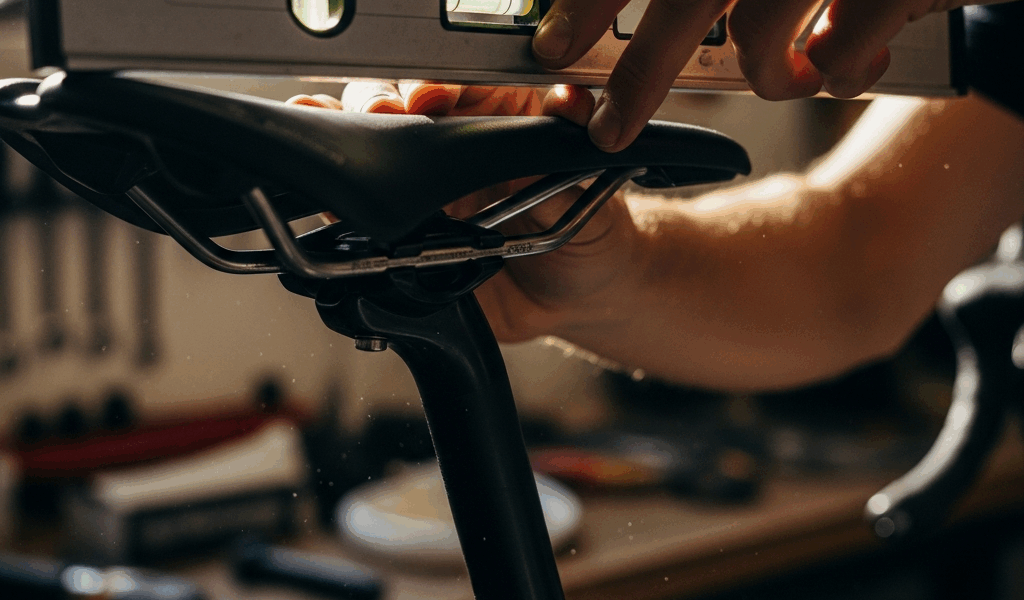
Check: lay a level across the flat portion of your saddle surface (not including the nose). If the bubble shows any tilt toward the nose-up position, that’s your problem. Adjust to perfectly level or 1-2 degrees nose-down for road bikes. For time trial or triathlon positions where your torso is more rotated forward, a slightly greater nose-down angle (2-3 degrees) prevents the pelvic rotation from driving pressure onto soft tissue.
Many riders set their saddle with a slight nose-up tilt because it feels secure — like they won’t slide forward. But that security comes at the cost of perineal compression. Level is the starting point. If you’re sliding forward off a level saddle, the issue is saddle fore-aft position or saddle shape, not tilt angle.
Saddle Height and Fore-Aft Position
Too low: When the saddle is too low, your hips rock side to side as you pedal because your legs can’t fully extend. That rocking motion creates friction and pressure shifts across the saddle surface with every pedal stroke. The cumulative effect over an hour is significant numbness that a higher saddle position eliminates.
Quick height check: sit on the saddle with your heel on the pedal at the 6 o’clock position. Your leg should be fully extended with no bend at the knee. When you clip in and pedal with the ball of your foot, this produces the slight knee bend (25-30 degrees) that is optimal for pedaling efficiency and tissue pressure.
Fore-aft position: The KOPS method (Knee Over Pedal Spindle) is a reasonable starting point — with the cranks horizontal, a plumb line from the front of your kneecap should fall roughly over the pedal axle. If the saddle is too far forward, your weight loads the nose. Too far back, and you’re reaching for the pedals and rotating your pelvis in a way that increases perineal contact.
Chamois and Shorts — What Actually Matters
Chamois cream is not optional for rides over an hour. It reduces friction between your skin and the chamois pad, which reduces the micro-irritation that leads to numbness over time. Apply directly to the chamois pad or to your skin — either works. Reapply for rides over 3 hours.
Your shorts matter more than most riders realize. A chamois pad with seams in the wrong location creates pressure ridges that compress exactly the tissue you’re trying to protect. If you’re experiencing numbness with one pair of shorts but not another, the shorts are the variable — not the saddle. Higher-quality bib shorts (Assos, Rapha, Castelli) use flat-lock stitching and laser-cut chamois pads specifically designed to eliminate pressure ridges. Cheaper shorts with raised seams running through the contact zone will cause numbness on any saddle.
Never wear underwear under cycling shorts. The extra layer creates seams and friction points that the chamois pad is specifically designed to eliminate.
Saddle Channel Width — When the Saddle Itself Is the Problem
Only after position is correct and shorts are appropriate should you consider the saddle itself. If you’ve checked tilt, height, fore-aft, and are using good shorts with chamois cream, and numbness persists — the saddle width or shape may not match your anatomy.
Measure your sit bone width at home: sit on a piece of corrugated cardboard on a hard surface. Stand up and measure the distance between the two deepest impressions. This number determines your saddle width — most saddles come in 2-3 widths (narrow, medium, wide) corresponding to sit bone measurements.
For riders who experience perineal numbness specifically (not sit bone discomfort), a saddle with a center channel or cutout provides relief by eliminating contact with soft tissue entirely. Specialized Power, ISM PR, and Selle Italia SLR Boost are popular options with deep center channels.
Flat vs curved saddle profile: riders with less hamstring flexibility generally do better on flat saddles (Specialized Power, ISM). Riders with good flexibility can often use curved saddles (Selle Italia) comfortably. A bike fit professional can assess this in minutes.
Indoor Trainer-Specific Numbness
Numbness is almost always worse on the indoor trainer than outdoors, and there’s a specific reason: you don’t move. Outdoor riding involves constant micro-adjustments — standing for hills, shifting weight through corners, moving on the saddle naturally. On a trainer, you sit in one position and pedal. The pressure point stays constant instead of shifting around.
Trainer-specific fixes: slightly more nose-down tilt (1-2 degrees beyond your outdoor setting) compensates for the fixed bike position. A rocker plate (Saris MP1, Inside Ride) adds natural side-to-side movement that mimics outdoor riding and shifts pressure points continuously. Standing intervals every 10-15 minutes — even 10 seconds out of the saddle restores blood flow and resets the pressure clock.
If numbness is a trainer-only problem and you’re fine outdoors, don’t buy a new saddle. Address the static position issue first. A $40 rocker plate or a habit of standing every 10 minutes solves what a $200 saddle won’t.




Stay in the loop
Get the latest cycle tech trends updates delivered to your inbox.