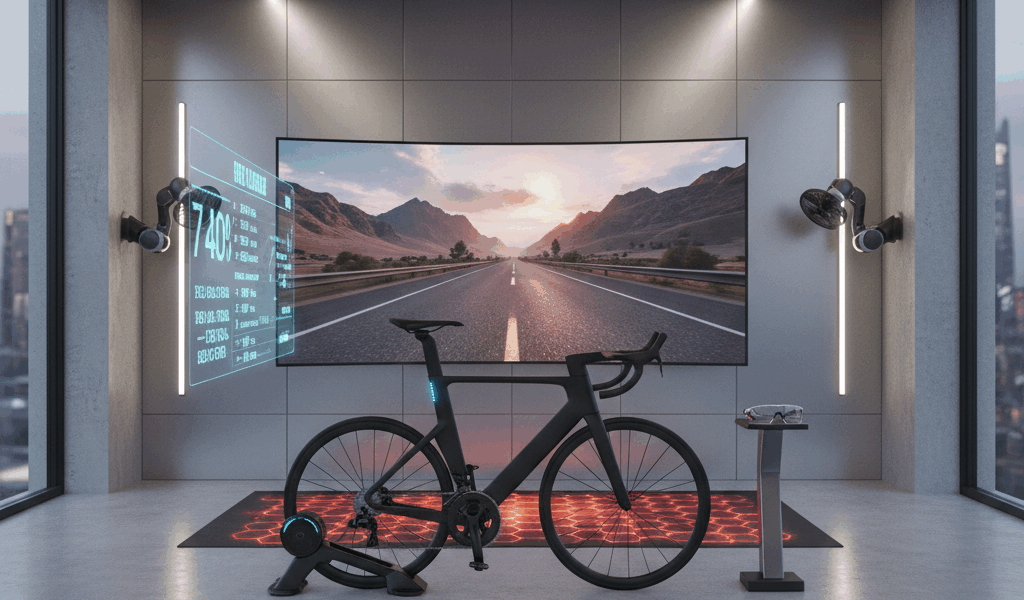
Introduction to Indoor Cycling in 2025
Indoor cycling has evolved from a simple winter fallback to a year-round training staple. Whether you’re avoiding dangerous roads, optimizing training time, or chasing virtual racing glory, a well-designed indoor setup can transform your cycling performance.
Recommended Indoor Trainers
This section includes affiliate links. We may earn a commission at no extra cost to you.
Wahoo KICKR SNAP Smart Indoor Trainer
Wheel-on smart trainer - great entry point
$499.99
Check Price on AmazonThis comprehensive guide covers everything you need to know about building and optimizing your indoor cycling space in 2025, from equipment selection to software choices to the often-overlooked environmental factors that affect your training quality.
This article includes affiliate links. We may earn a commission at no extra cost to you.
Essential Equipment: Building Your Foundation
Smart Trainers vs. Dedicated Smart Bikes
The fundamental choice in indoor cycling is between a smart trainer that holds your existing bike and a dedicated smart bike designed exclusively for indoor use.
Smart trainers connect to your rear wheel or replace it entirely. Wheel-on trainers are budget-friendly but require tire changes for outdoor riding. Direct-drive trainers eliminate this hassle by connecting directly to your drivetrain, providing more accurate power measurement and quieter operation.
The current market leaders in direct-drive trainers include the Wahoo KICKR, Tacx NEO series, Elite Drivo, and Saris H3. Prices range from $600 to $1,400, with accuracy typically within 1-2% of actual power output.
Dedicated smart bikes like the Wahoo KICKR Bike, Tacx NEO Bike, and the new Zwift Ride eliminate the need to mount your outdoor bike entirely. These units offer adjustable geometry to match your road bike fit, instant resistance changes, and often better build quality for heavy training loads.
The trade-off is price ($2,000-$4,000) and space requirements. Smart bikes make sense if you ride indoors more than three times weekly and want to keep your outdoor bike permanently road-ready.
Heart Rate Monitors
While power is the gold standard for training, heart rate provides crucial physiological context. A chest strap monitor remains the most accurate option, though optical arm bands have improved significantly.
The Polar H10 and Wahoo TICKR X are industry standards for chest straps. If you prefer optical sensing, the Polar Verity Sense and Wahoo TICKR FIT arm bands offer reasonable accuracy with improved comfort.
Dual-band monitors that transmit via both Bluetooth and ANT+ ensure compatibility with any app or device combination.
Fans: The Most Underrated Equipment
Indoor cycling generates enormous heat without the natural airflow of outdoor riding. Studies show that inadequate cooling can reduce power output by 15-20% and significantly increase perceived exertion.
A single desk fan pointing at your face is insufficient. Effective cooling requires multiple fans creating cross-ventilation. Many experienced indoor cyclists use three fans: one high-powered fan directed at the torso from the front, and two smaller fans providing side airflow.
The Wahoo KICKR Headwind is a smart fan that adjusts speed based on your heart rate or power output. While expensive, it provides automatic intensity matching that simulates outdoor conditions more closely than fixed-speed alternatives.
Floor Protection and Sound Dampening
Trainer vibrations can damage floors and disturb neighbors. A dedicated trainer mat protects flooring and absorbs some noise, while rocker plates that allow natural bike movement can reduce fatigue during long sessions.
For apartment dwellers, consider trainer desk risers that isolate vibration from the floor. The Saris MP1 platform and InsideRide E-Flex roller system offer sophisticated motion platforms that dramatically improve ride feel while reducing transmitted vibration.
Software Platforms: Making the Right Choice
Zwift: The Social Gaming Option
Zwift dominates the indoor cycling market through its gamification approach. You pedal through virtual worlds, join group rides, compete in races, and watch your avatar climb virtual mountains.
The platform excels at motivation. Real-time visibility of other riders, achievement badges, and level progression create engagement that makes structured training more palatable. The racing scene is particularly robust, with events running around the clock across multiple virtual courses.
Zwift’s training plans are adequate but not personalized. The app prescribes workouts based on broad categories rather than individual physiology. For serious performance development, many users supplement Zwift with external coaching or training platforms.
At $19.99/month, Zwift is the most expensive mainstream option. However, the recent TrainerRoad integration allows users to follow personalized TrainerRoad plans while riding in Zwift’s worlds, combining the best of both approaches.
TrainerRoad: Pure Performance Focus
TrainerRoad takes a clinical approach to cycling improvement. The platform uses machine learning to create adaptive training plans that adjust based on your performance and recovery indicators.
There’s no virtual world or avatar. You see your power numbers, target zones, and interval structure on a minimalist interface designed to keep you focused on executing the workout.
The strength of TrainerRoad is its training science. Plans are periodized correctly, progression is systematic, and the adaptive system ensures workouts remain appropriately challenging without risking overtraining.
Many TrainerRoad users run YouTube videos, Netflix, or podcasts on a separate screen during workouts. The platform acknowledges that pure numbers aren’t inherently engaging and doesn’t try to compete with Zwift’s entertainment value.
Rouvy: Real-World Routes
Rouvy differentiates itself through video-based routes filmed on actual roads. Rather than cartoon-like virtual worlds, you ride through realistic footage of famous climbs and scenic destinations.
The recent acquisitions of BKOOL and FulGaz have expanded Rouvy’s route library significantly. The platform now offers thousands of real-world routes with accurate gradient simulation.
For riders motivated by destination cycling, Rouvy provides a unique proposition. You can preview routes you plan to ride in person or virtually experience climbs you may never visit.
Wahoo SYSTM and RGT
Wahoo’s training ecosystem includes SYSTM (structured training with video content) and RGT (free virtual cycling similar to Zwift). The combination provides a flexible alternative to the major platforms.
SYSTM excels in producing engaging video-based workouts with professional production quality. The Sufferfest workout library, now integrated into SYSTM, offers challenging sessions with motivational coaching.
RGT provides free access to virtual riding and racing, making it an excellent entry point for new indoor cyclists testing the waters before committing to paid platforms.
Training Methodology: Getting Results
Understanding Power Zones
Effective indoor training requires understanding your power zones. Most systems use a model based on Functional Threshold Power (FTP), the maximum power you can sustain for approximately one hour.
Zone 1 (Active Recovery): Below 55% of FTP. Easy spinning to promote recovery without adding training stress.
Zone 2 (Endurance): 55-75% of FTP. The foundation of aerobic development. Most of your training volume should occur here.
Zone 3 (Tempo): 75-90% of FTP. Moderate intensity that builds aerobic capacity. Useful but often overused by self-coached athletes.
Zone 4 (Threshold): 90-105% of FTP. Hard efforts at or near your sustainable maximum. Effective for improving FTP but requires adequate recovery.
Zone 5 (VO2max): 105-120% of FTP. Short, intense intervals that develop maximal oxygen uptake. Typically 3-8 minute efforts.
Zone 6 (Anaerobic): Above 120% of FTP. Very short, very hard efforts developing anaerobic capacity. Typically 30 seconds to 2 minutes.
Structuring Your Training Week
Effective training follows the principle of progressive overload: gradually increasing stress while allowing adequate recovery. For most amateur cyclists, this means 3-5 structured training sessions per week with at least one complete rest day.
A typical week might include: two Zone 2 endurance sessions of 60-90 minutes, one threshold workout with 2-3 intervals of 8-20 minutes, and one VO2max session with shorter, harder efforts.
The specific distribution depends on your goals, available time, and training history. New cyclists should emphasize longer Zone 2 sessions to build aerobic foundation. Experienced riders preparing for specific events may shift toward more intensity.
Recovery and Adaptation
Training stress triggers adaptation, but adaptation occurs during recovery. Many cyclists undermine their progress by failing to recover adequately between hard sessions.
Indoor training can exacerbate this problem. Without natural outdoor riding variation, some athletes complete every session at near-threshold intensity. The result is chronic fatigue without corresponding improvement.
True Zone 2 riding should feel easy, even boring. If you’re watching Zwift races and unconsciously pushing too hard, consider using platforms like TrainerRoad that enforce prescribed power targets.
Environmental Optimization
Temperature Control
Ideal training temperature is lower than most people expect: 60-68°F (15-20°C) for hard sessions. Many home environments are warmer, requiring aggressive fan use and potentially air conditioning.
A dedicated training space allows temperature control without affecting household comfort. Garages, basements, and spare rooms can be maintained at training-appropriate temperatures even when the rest of the home is warmer.
Hydration and Fueling
Indoor riding typically causes greater fluid loss than outdoor cycling at equivalent intensity. The lack of airflow concentrates heat, increasing sweat rates significantly.
A two-bottle setup is minimum for sessions over 45 minutes. Consider electrolyte drinks rather than plain water for longer sessions, and have a towel readily accessible to keep equipment dry.
For sessions over 90 minutes, on-bike fueling becomes important. Energy gels, bars, or drink mixes should be within reach without disrupting your pedaling rhythm.
Entertainment and Distraction
Indoor cycling is mentally demanding. Without changing scenery, the mind tends to fixate on discomfort and remaining time. Successful indoor cyclists develop distraction strategies.
Music, podcasts, and video content can shift attention away from effort perception. Some riders prefer complete engagement with their training data, but most benefit from some form of entertainment during longer sessions.
The quality of your entertainment setup matters. A small phone screen positioned awkwardly creates frustration. Consider a larger tablet or TV mounted at eye level for comfortable viewing throughout your workout.
Common Mistakes to Avoid
Neglecting Position and Fit
Your indoor bike position should match your outdoor position as closely as possible. Subtle differences compound over long training blocks, potentially causing injury or creating position habits that don’t transfer outdoors.
If using a smart trainer, ensure your bike setup remains consistent. If using a dedicated smart bike, take time to accurately replicate your road bike measurements.
Training Too Hard, Too Often
The convenience of indoor training enables daily riding, but daily hard riding leads to overtraining. Easy days must be truly easy, and rest days should involve no cycling at all.
Monitor recovery indicators like resting heart rate, sleep quality, and general fatigue. Training platforms increasingly incorporate recovery metrics, but subjective assessment remains valuable.
Ignoring Equipment Maintenance
Smart trainers require periodic maintenance. Belt tension, bearing lubrication, and firmware updates affect accuracy and longevity. Follow manufacturer recommendations for maintenance intervals.
For wheel-on trainers, tire wear is accelerated compared to outdoor riding. Dedicated trainer tires last longer and provide better power transmission than road tires.
Conclusion: Building Your Optimal Setup
The perfect indoor cycling setup balances equipment quality, software engagement, environmental control, and training methodology. No single solution works for everyone.
Start with essentials: a reliable trainer, adequate cooling, and a training platform that motivates you. Refine your setup over time based on experience. The goal is sustainable, enjoyable indoor training that complements your outdoor riding and advances your cycling performance.
Indoor cycling technology continues advancing rapidly. Stay informed about new developments, but avoid equipment chasing. The limiting factor in cycling improvement is consistent, well-structured training, not marginal equipment upgrades.




Stay in the loop
Get the latest cycle tech trends updates delivered to your inbox.