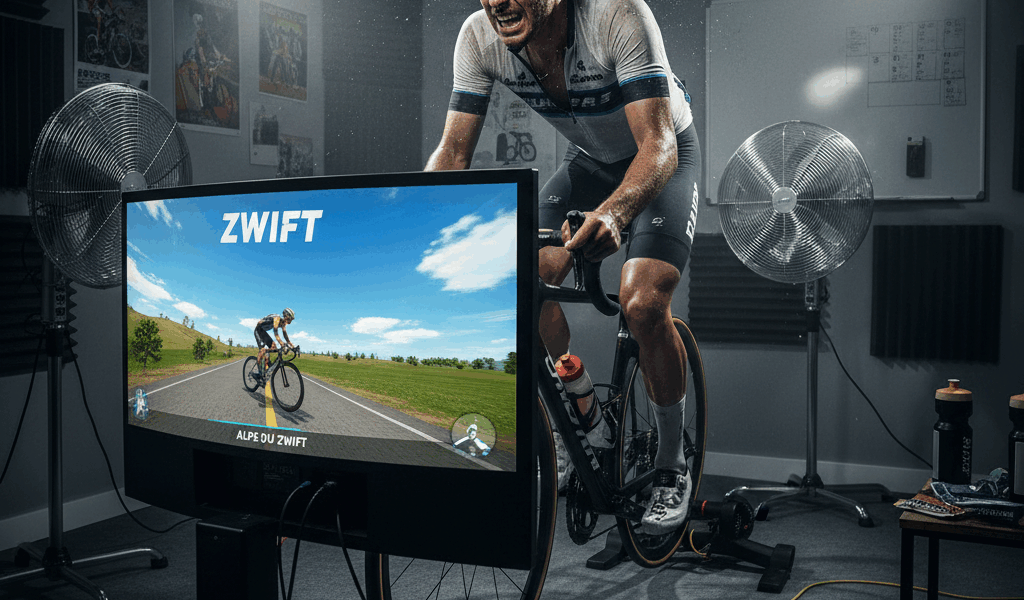
Smart trainers have revolutionized indoor cycling, transforming basement suffering into connected, game-like experiences. But choosing between direct drive and wheel-on designs—and navigating the current market—requires understanding what each type offers and how the options have evolved.
Direct Drive vs Wheel-On: The Fundamental Difference
Wheel-On Trainers
Wheel-on trainers clamp to your rear wheel, which presses against a roller. Your tire drives the roller, which connects to the resistance unit. The bike’s wheel remains in place—you simply secure the bike and ride.
How they work: Resistance comes from a roller mechanism, typically using magnetic, fluid, or electromagnetic systems. Smart wheel-on trainers add controlled resistance that adjusts automatically based on virtual terrain or workout targets.
Direct Drive Trainers
Direct drive trainers replace your rear wheel entirely. You remove the wheel, mount the bike directly to the trainer’s built-in cassette and freehub, and the drivetrain connects directly to the resistance unit.
How they work: The chain drives the trainer’s flywheel directly, eliminating tire slip and wear. The mechanical connection provides more accurate power measurement and faster resistance changes.
Direct Drive Advantages
Accuracy
Without tire slip affecting readings, direct drive trainers achieve ±1-2% power accuracy versus ±2-5% for wheel-on units. This matters for structured training, FTP testing, and racing where consistent numbers affect performance assessment.
Quieter Operation
No tire noise means significantly quieter sessions. Most direct drive trainers produce only drivetrain and fan noise—quiet enough for apartment use or early-morning sessions without waking the household.
No Tire Wear
Wheel-on trainers eat through rear tires quickly. Direct drive eliminates this cost and the hassle of mounting trainer-specific tires.
Better Road Feel
Larger flywheels and direct mechanical connection create inertia that more closely mimics outdoor riding. The pedal stroke feels smoother, especially during hard efforts.
Faster Resistance Changes
Virtual terrain changes feel more immediate. Climbing a virtual grade on Zwift translates to resistance changes within 1-2 seconds on quality direct drive trainers.
Wheel-On Advantages
Lower Cost
Smart wheel-on trainers start around $300-400 versus $600+ for direct drive. For occasional use or budget-conscious riders, wheel-on provides smart functionality at lower entry price.
Simpler Setup
No wheel removal or cassette installation required. Mount the bike, inflate the tire, and ride. Easier for riders who don’t want to deal with wheel swaps.
Works with Any Wheel
No compatibility concerns with thru-axle standards, cassette body types, or freehub width. Any bike with a quick-release or thru-axle skewer fits.
Lower Weight (for transport)
Wheel-on trainers are generally lighter and more portable for those who need to move their setup.
2026 Direct Drive Market
Wahoo KICKR v6
The current KICKR adds WiFi connectivity and improved accuracy (±1%) over previous versions. The massive flywheel provides excellent road feel, and the established ecosystem integrates seamlessly with Wahoo components. AXIS feet allow the trainer to rock slightly side-to-side, reducing the locked-in feeling. $1,299.
Wahoo KICKR Core
The Core uses similar technology in a smaller package with slightly less flywheel inertia. Still offers ±2% accuracy and excellent build quality at $899—often the sweet spot for serious indoor cyclists.
Tacx NEO 3M
The latest NEO adds motion capabilities that allow the bike to tilt and shift during rides, simulating descents and sprints. Already known for silent operation (no belt or chain drive), the NEO 3M represents premium indoor riding. $1,699.
Tacx Flux 2
Tacx’s mid-range option offers ±2.5% accuracy with solid build quality. More affordable than the NEO while maintaining the brand’s quality. $899.
Elite Suito-T
Elite’s flagship hits an excellent price/performance point. Includes a cassette (saving $50-100), folds for storage, and delivers ±2.5% accuracy. The integrated power meter compares well with more expensive units. $799.
Saris H3
Known for exceptional accuracy (±2%) and solid build quality at a competitive price. The H3 offers good value for serious trainers who prioritize measurement precision. $999.
Zwift Hub
Zwift’s entry into hardware disrupted the market with competitive specs at aggressive pricing. The Hub includes a cassette and offers Zwift Cog compatibility for ultra-quick bike swaps. ±2.5% accuracy, 1800W max resistance. $499—exceptional value.
2026 Wheel-On Market
Wahoo KICKR Snap
The best smart wheel-on trainer available. ±3% accuracy, smooth resistance feel, and Wahoo’s excellent app integration. Quick release and thru-axle compatible. $449.
Tacx Flow Smart
Budget-friendly smart trainer with basic functionality. Accuracy is lower (±3%) and road feel is less refined, but it works for occasional use and Zwift compatibility. $349.
Elite Suito-T Flow
Elite’s entry-level smart trainer offers reasonable accuracy at a competitive price. Foldable design helps with storage. $399.
Key Specifications Explained
Maximum Power
How much resistance the trainer can provide. Look for at least 1,500W for serious training and sprint efforts. Most quality trainers now offer 1,800-2,200W maximum.
Maximum Simulated Grade
How steep a virtual climb the trainer can simulate. 15-20% handles most virtual worlds. Above 20% is rarely needed except for extreme mountain stage simulations.
Flywheel Weight
Heavier flywheels create more realistic inertia. Direct drive units typically use 10-16 lb flywheels; larger is generally better for road feel.
Protocol Support
ANT+ FE-C and Bluetooth FTMS allow trainers to communicate with apps and head units. Ensure your chosen trainer supports both for maximum compatibility.
Cassette Compatibility
Direct drive trainers require a cassette (the gear cluster), which usually isn’t included:
- Shimano HG: 8-11 speed (most common)
- Shimano Microspline: 12-speed Shimano
- SRAM XDR: 12-speed SRAM road
- SRAM XD: 12-speed SRAM mountain
- Campagnolo: N3W standard for newer groups
Match the cassette to your bike’s drivetrain. Some trainers include a cassette; others require separate purchase ($30-200 depending on quality).
Making Your Choice
Choose Direct Drive If:
- You train indoors multiple times per week
- Power accuracy matters for training zones and testing
- You want quieter operation
- Budget allows $600+ investment
Choose Wheel-On If:
- Indoor training is occasional or seasonal
- Budget is tight
- You don’t want to deal with wheel removal
- Multiple family members with different bikes will use it
Best Value Recommendations
Best Overall: Wahoo KICKR Core ($899)—excellent quality, proven reliability, great ecosystem
Best Budget Direct Drive: Zwift Hub ($499)—includes cassette, surprisingly capable
Best Wheel-On: Wahoo KICKR Snap ($449)—best smart wheel-on available
Premium Pick: Tacx NEO 3M ($1,699)—silent operation, motion capability, best road feel



Stay in the loop
Get the latest wildlife research and conservation news delivered to your inbox.