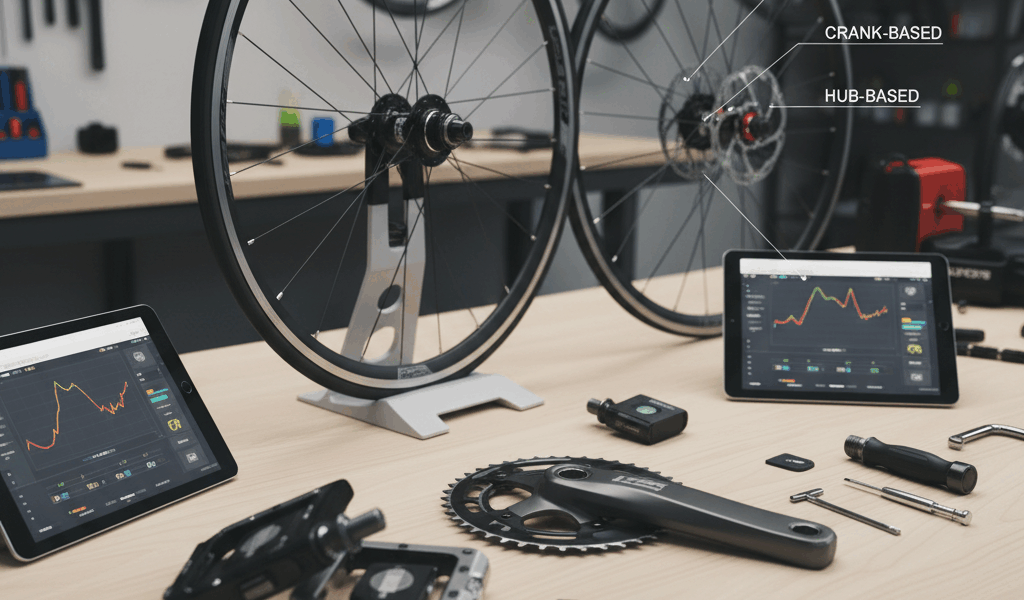
Power meters transformed cycling training from guesswork into precise science. But choosing between crank-based, pedal-based, hub-based, and spider-based power meters involves tradeoffs that marketing materials rarely explain clearly.
This guide covers everything I learned from three years of testing power meters across different price points and installation types. By the end, you will understand which style fits your riding and budget.
How Power Meters Actually Work
All power meters measure the same fundamental thing: the force applied to move your bike forward, multiplied by the rate of that application. The resulting number, expressed in watts, represents mechanical energy output per second.
The strain gauge inside each power meter flexes microscopically under load. Electronics convert this flex into a digital signal broadcast to your bike computer. This process happens hundreds of times per second to produce real-time power data.
Location matters because each mounting position experiences force differently. Pedal-based meters measure force at the pedal axle. Crank-based meters measure flex in the crank arm. Spider-based meters sit between the crank and chainring, measuring force transmission to the chain.
Single-Sided vs Dual-Sided Measurement
Single-sided power meters measure one leg and double the result. This approach assumes both legs contribute equally, which rarely happens in reality.
Most cyclists have a dominant leg producing 52-55% of total power. Single-sided meters systematically overestimate or underestimate total power depending on which leg they measure.
For training purposes, this error matters less than you might think. Consistency beats absolute accuracy for tracking fitness changes. If your power meter consistently reads 3% high, your fitness trends remain valid.
Dual-sided meters eliminate this bias and provide left/right balance data. This information helps identify pedaling asymmetries that might indicate injury risk or inefficiency.
Crank Arm Power Meters Explained
Crank arm power meters like Stages, 4iiii, and some Shimano models install directly onto the crank arm. They offer an attractive combination of affordability and compatibility.
Installation requires removing your existing non-drive-side crank and replacing it with a power-measuring version. This process takes about 20 minutes with basic tools.
Crank arm meters excel at affordability. Single-sided options start under $400. They work with most crankset standards and transfer easily between bikes sharing the same crank type.
Downsides include limited dual-sided options and occasional accuracy issues when flexing hard during climbs. Some brands handle high-torque situations better than others.
Pedal-Based Power Meters
Pedal power meters like Garmin Rally, Favero Assioma, and Wahoo Speedplay measure force at the pedal axle. They have become increasingly popular due to easy installation and bike-to-bike transferability.
Swapping pedal power meters between bikes takes under two minutes with a pedal wrench. This portability makes pedal meters attractive for cyclists with multiple bikes.
Pedal meters come in both single-sided and dual-sided versions. Dual-sided options provide true left/right measurement and pedaling dynamics data showing where power occurs through each pedal stroke.
Battery replacement on pedal meters ranges from simple coin-cell swaps to rechargeable systems requiring periodic charging. Check battery life specifications against your weekly riding volume.
Weight considerations matter for weight-conscious cyclists. Pedal meters add 100-200 grams compared to standard pedals. This weight sits at rotating mass, affecting acceleration feel slightly.
Spider-Based Power Meters
Spider power meters mount between your crankset and chainrings. They measure force as it transmits from the crank to the chain, providing inherently dual-sided measurement without separate left and right units.
Installation complexity exceeds other options. You must remove your crankset, swap the spider, and reinstall everything with proper torque specifications. Professional installation costs $50-100 at most shops.
Spider meters offer excellent accuracy because they measure the same force your chain experiences. They avoid the assumptions and compromises of crank arm or pedal placement.
Compatibility limitations exist. Not all cranksets accept aftermarket spiders. Check your crankset model against manufacturer compatibility lists before purchasing.
Hub-Based Power Meters
Hub power meters like PowerTap sit in the rear wheel hub. They measure force at the point of propulsion, providing accurate total power data.
Hub meters lost popularity as other options improved, but they remain accurate and durable. Their main limitation is being wheel-specific. Changing wheels means losing power data unless both wheels have meters.
For trainers and indoor riding, hub meters work well. They cost less than spider meters and provide excellent consistency.
Accuracy Standards and Real-World Testing
Power meter manufacturers claim accuracy between 1% and 2%. Independent testing often shows higher variation, especially across temperature ranges and during extreme efforts.
I tested four power meters simultaneously over six months of training. The results revealed that claimed accuracy represents best-case scenarios under controlled conditions.
Real-world accuracy affected by temperature changes, moisture, impact shocks, and user calibration habits. A meter claiming 1% accuracy might show 3-4% variation across seasons without regular calibration.
Calibration frequency matters more than initial accuracy claims. Meters with simple calibration procedures encourage regular calibration, maintaining accuracy over time.
Temperature Compensation
Electronics in power meters respond to temperature changes. Without compensation, readings drift as your ride warms up or as outdoor temperatures change.
Quality power meters include automatic temperature compensation. They measure internal temperature and adjust readings accordingly.
Budget meters sometimes skip sophisticated temperature handling. These units may show artificially low power during cold starts that gradually climbs as electronics warm up.
Always zero-offset calibrate your meter at ride start after it reaches ambient temperature. This practice minimizes temperature-related drift.
Battery Life Considerations
Power meter battery life varies dramatically by type and usage. CR2032 coin cells in crank arm meters typically last 200-300 hours. Rechargeable pedal meters need charging every 30-100 hours.
Calculate weekly riding hours against battery specifications. Nothing ruins a training ride like discovering a dead power meter battery at the start.
Carry spare batteries for coin-cell meters. Keep rechargeable meters on a charging schedule aligned with your training rhythm.
Software Features and Data Quality
Beyond raw power, modern meters provide additional metrics: pedaling smoothness, torque effectiveness, left/right balance, and power phase analysis.
These advanced metrics help identify pedaling inefficiencies. However, their usefulness varies by riding style. Sprinters benefit from power phase data. Steady-state riders may find basic power sufficient.
Data recording rate affects file sizes and analysis granularity. Most meters record at 1Hz by default. Higher rates provide more detail but create larger files and drain batteries faster.
Choosing Based on Riding Style
Your riding priorities should guide power meter selection. Competitive racers benefit from dual-sided accuracy and advanced metrics. Casual trainers need basic consistent power data.
Multi-bike riders should consider pedal meters for easy swapping. Single-bike riders can optimize for accuracy with spider-based options.
Indoor trainers using smart trainers already have power measurement. Adding a separate power meter provides backup data and outdoor consistency but duplicates indoor functionality.
Installation and Maintenance Reality
Installation difficulty ranges from trivial to professional-required depending on power meter type. Pedal meters install in minutes. Spider meters demand crankset removal and torque specifications.
Long-term maintenance includes firmware updates, occasional calibration, and battery management. Most modern meters handle updates through smartphone apps.
Waterproofing varies between models. Some meters handle rain and bike washing without concern. Others require careful moisture avoidance. Read warranty terms regarding water exposure.
Price-to-Performance Analysis
Power meter prices range from $300 single-sided crank arms to $1,500 dual-sided spider systems. The law of diminishing returns applies strongly.
A $400 single-sided meter provides 85-90% of the training benefit of a $1,200 dual-sided spider meter. The premium buys absolute accuracy and advanced metrics that matter most to elite competitors.
For most amateur cyclists, mid-range pedal meters around $600-800 provide the best combination of accuracy, features, and transferability.
My Testing Conclusions
After three years of comparative testing, the Favero Assioma Duo offered the best value in dual-sided measurement. The Garmin Rally provided excellent features but at higher cost. Stages and 4iiii dominated the budget single-sided category.
Accuracy differences between major brands rarely exceeded 2% when properly calibrated. The practical training impact of these small variations is negligible for most riders.
Buy based on installation preference, bike compatibility, and budget rather than obsessing over published accuracy claims. Any quality power meter from a reputable brand will improve your training.


Stay in the loop
Get the latest wildlife research and conservation news delivered to your inbox.