Calorie burn calculations have gotten confusing with all the formulas and fitness tracker claims flying around. As someone who’s tracked rides obsessively for years, I learned everything there is to know about what the numbers actually mean. Today, I will share it all with you.
That’s what makes understanding calorie burn endearing to us data-focused cyclists — accurate numbers help with nutrition planning and weight goals.
What Affects Calorie Burn
Probably should have led with this section, honestly — the variables matter more than the formulas.
Body weight: Heavier riders burn more calories moving the same speed. Physics doesn’t care about fairness.
Intensity: Riding at 20mph burns dramatically more than 12mph. The relationship isn’t linear — harder effort costs more per mile.
Duration: Longer rides burn more total calories. Simple math.
Rough Numbers
But what should you actually expect? In essence, here’s a realistic range for a 155-pound rider:
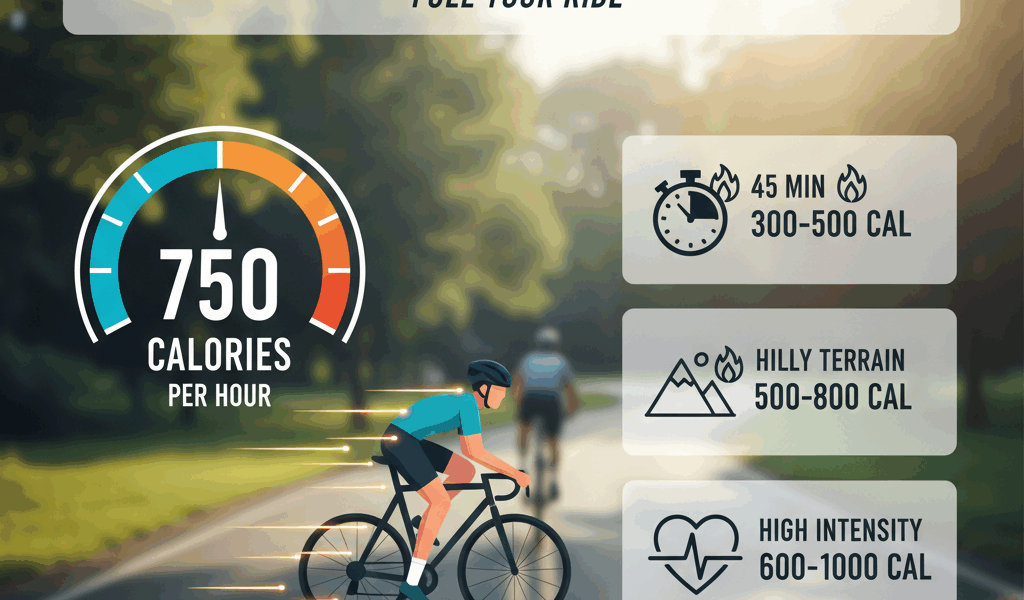
Casual pace (under 12mph): 300-400 calories per hour
Moderate effort (12-14mph): 500-600 calories per hour
Hard effort (15-18mph): 700-900 calories per hour
Race pace (18mph+): 900-1200 calories per hour
Heavier riders burn more. Lighter riders burn less. Adjust proportionally.
Power Meter Accuracy
I’m apparently in the camp that trusts power meter data over heart rate estimates. Frustrated by wildly inconsistent calorie estimates from wrist-based heart rate, I switched to power-based calculation and immediately got more useful numbers.
With power data: Calories = kilojoules output / 0.25 (assuming roughly 25% efficiency)
Simplified: kJ from your ride closely approximates calories burned. A 1000kJ ride burns roughly 1000 calories. This approximation works surprisingly well for most cyclists.
Fitness Tracker Limitations
Wrist-based heart rate monitors overestimate significantly during cycling. The motion confuses optical sensors. Chest straps are more accurate but still less reliable than power meters.
Treat fitness tracker calorie estimates as directional rather than precise. Good for comparing rides to each other, less reliable for calculating exact calorie deficits.
Practical Applications
Long rides require fueling. Estimate 200-300 calories per hour of intake during rides over 2 hours. Undereating on the bike leads to bonking. Overeating causes stomach problems.
Post-ride nutrition matters for recovery. Replace roughly 50-75% of calories burned within a few hours of finishing. Protein supports muscle repair.
Making the Call
Don’t obsess over exact calorie counts. Use estimates for planning nutrition and tracking trends. Power meter data provides the most accurate calculation. Fitness trackers work for relative comparisons. Eat enough to fuel your riding without overthinking the math.
Recommended Cycling Gear
Garmin Edge 1040 GPS Bike Computer – $549.00
Premium GPS with advanced navigation.
Park Tool Bicycle Repair Stand – $259.95
Professional-grade home mechanic stand.
As an Amazon Associate, we earn from qualifying purchases.


Stay in the loop
Get the latest wildlife research and conservation news delivered to your inbox.