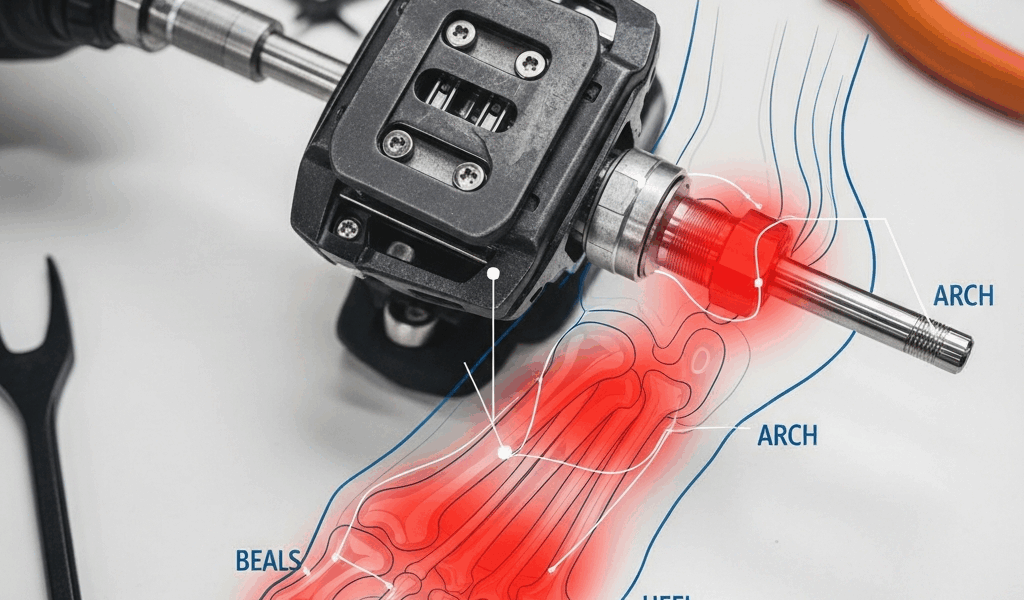
Why Clipless Pedals Cause Foot Pain in the First Place
Clipless pedal pain has gotten complicated with all the conflicting advice flying around. Everyone’s got a theory. Bike shop guy says get a professional fit. Reddit says buy new shoes. Your riding buddy says just push through it. Meanwhile, your feet are on fire by kilometer 40 and you’re seriously reconsidering the whole cycling thing.
Here’s the actual truth: it almost always comes down to three things you can control yourself — cleat position front-to-back, float restriction, and shoe fit. That’s it. None of these require a $300 bike fit session or a sports podiatrist, though those aren’t bad ideas eventually. What matters right now is understanding that your foot pain is a mechanical problem with a mechanical solution. Your feet aren’t broken. The system is just misaligned.
But what is cleat position, really? In essence, it’s where the metal plate on your shoe contacts the pedal. But it’s much more than that — it determines how pressure distributes across your entire foot, which nerves get compressed, and whether your knee tracks correctly for hours at a time. Float mismatch creates a completely different problem. Your feet want to rotate naturally through each pedal stroke. When the pedal won’t let them, your arch and knee spend hours compensating. Shoe stiffness compounds everything — a carbon-soled shoe paired with an overtightened BOA dial can compress the nerves in your forefoot within 30 minutes.
These three variables talk to each other constantly. That’s what makes diagnosis genuinely tricky for most cyclists. So, without further ado, let’s figure out exactly what’s hurting you.
Hot Foot or Burning Under the Ball of Your Foot
I spent three full seasons dealing with hot foot on anything over 90 minutes. Stubbornly convinced it was just something you tolerated. Don’t make my mistake.
That specific burning sensation under your metatarsal heads — right where the ball of your foot lives — is actually telling you something precise. Your cleat is too far forward relative to the pedal axle. The axle ends up sitting under your arch rather than directly under the widest part of your foot. All your power output concentrates on a smaller surface area than intended. Add 90 minutes of pedaling, summer heat, and sweat, and that zone heats up fast.
The fix requires a 4mm hex key and maybe 20 minutes of your time. Loosen the cleat bolts — they’re typically torqued to 5 to 6 Nm, which is snug but not welded in place. Look at your shoe sole and find the widest part of your metatarsal heads, basically where your toes meet your foot. That landmark should sit directly over the pedal axle. If your cleat is forward of that point, shift it rearward in 2 to 3 millimeter increments. Retighten. Do a 20-minute test ride before committing.
I moved mine back nearly a full centimeter total — across three separate adjustments. Felt completely wrong the first ride. Felt completely right by the third. The efficiency drop was negligible. The hot foot disappeared entirely after years of just accepting it as part of long rides.
Still getting some heat after repositioning? Add a metatarsal pad. Spenco makes a thin adhesive version that sits inside your shoe just ahead of the ball of your foot — runs about $9 on Amazon, model varies by size. Distributes pressure across a broader area. Works faster than you’d expect for something that costs less than a coffee stop.
Numbness or Tingling in Your Toes
Probably should have opened with this section, honestly — numb toes affect more cyclists than hot foot does, and the fix is often embarrassingly simple.
Numb toes mean compression. Either your shoe is squeezing nerves directly, or your cleat position is adding mechanical pressure somewhere between your ankle and your toes. Start with the obvious one first.
On your next long ride, loosen your closure system before you clip in. BOA dial? Back it off one full turn from wherever you normally set it. Buckle closures? Loosen specifically the forefoot strap — the one across the widest part of your foot. Your heel should feel planted and secure. Your forefoot should feel snug, not compressed. Ride 60 minutes at normal effort. If the numbness drops noticeably, you found it. Tighten back up just enough to keep your heel from lifting. That’s your new baseline.
Still numb after that? Move to cleat position. A cleat that sits too far forward can push your foot into a slight extension that irritates the plantar nerves continuously. Shift it rearward 2 to 3 millimeters and retest — yes, even if you already adjusted it for hot foot. Sometimes one change overlaps the other.
I’m apparently a wide-foot-narrow-heel combination, and Shimano shoes work for me while Giro narrow lasts never did — even in the same size. Shoe geometry is genuinely brand-specific. Giro tends narrower through the forefoot than Fizik, which runs slightly wider. If you sized down aggressively or bought a brand known for aggressive fits, you might simply need a half size up. Many cyclists ride a full size larger than they initially assume. Go bigger and the problem sometimes just evaporates.
One more thing worth saying plainly: carbon-soled shoes amplify numbness. A stiff sole is faster — that part is true — but it doesn’t forgive pressure distribution errors the way a nylon sole does. If you’re riding high-end carbon shoes and experiencing numbness on rides beyond 60 minutes, the shoe itself is probably part of the picture.
Knee or Arch Pain That Traces Back to Cleat Float
Float is the rotational freedom your foot has before the cleat releases from the pedal. Shimano’s yellow SPD-SL cleats give you 6 degrees. Their blue cleats give you 2 degrees. Their red cleats are fixed — zero float. Keo and other road systems have their own ranges. Too much float and your foot wanders, power transfer feels mushy. Too little and your feet feel mechanically locked, especially after 45 minutes of riding.
Float mismatch creates arch pain and lateral knee pull because your stabilizer muscles spend the entire ride fighting a restriction that shouldn’t be there. Your foot naturally wants to rotate slightly through each pedal stroke — this is biomechanics, not weakness, not poor technique. When the pedal prevents that rotation, your arch tightens and your knee drifts inward searching for a comfortable angle. Do this for three hours and you’ll feel it for two days.
Here’s how to identify the problem. Ride for 45 to 60 minutes at your normal pace. After — not during — check two things. Do your feet feel locked or stuck when you try to rotate them off the pedal? Does your knee track visibly inward during the down stroke? Both yes? Float is too restricted. Start with 6-degree float cleats. That range works for roughly 70 percent of cyclists without any further adjustment.
Conversely, if your pedaling feels sloppy — like your foot is searching for purchase on each stroke — you might actually have too much float. Some riders with very stable ankle mechanics genuinely perform better on fixed or near-fixed float. That’s rare, but it happens. The signal is clear: your power output on climbs feels cleaner and more direct with less rotational movement. Trust that signal.
Small float changes feel strange for three to five rides. Give your nervous system a week before deciding something isn’t working. Two weeks is a more honest trial period.
Quick Cleat Position Checklist Before Your Next Ride
- Ball of your foot sits directly over or slightly behind the pedal axle — not in front of it
- Cleat bolts torqued to 5 to 6 Nm — snug but not stripped
- Float setting matches your natural foot rotation — start at 6 degrees if you’re unsure
- Shoe closure snug at the heel and midfoot, but forefoot not compressive
- No gaps between your foot and the shoe sole; insoles sitting completely flat
- Cleats aligned parallel to your foot — not angled inward or outward
- Metatarsal pad installed if hot foot persists after repositioning
- Cleat bolts rechecked every 50 to 75 riding hours — they back out from vibration
Run through this before your next ride. Most foot pain resolves with one or two of these adjustments — usually the cleat position or the closure tension, sometimes both together. If pain is still there after two solid weeks of tweaking, a professional bike fit is genuinely worth its cost at that point. But until then, you have everything you need to diagnose this yourself.

Stay in the loop
Get the latest cycle tech trends updates delivered to your inbox.