Where Does It Hurt — Your Knee Pain Diagnosis
Cycling knee pain has gotten complicated with all the conflicting advice flying around. Ice it. Stretch it. Buy new shoes. Take two weeks off. I tried all of it. Spent two months adjusting my training, dropped probably $180 on compression sleeves, and religiously stretched my hip flexors every single morning — all while the real problem was sitting right under my seat. Literally.
It took a bike fitter named Marcus to ask me one question: “Where exactly does it hurt?” That was it. That was the whole diagnosis.
This article includes affiliate links. We may earn a commission at no extra cost to you.
Most cyclists assume knee pain is a medical issue. Sometimes it is. But probably 70% of the time, it’s a bike fit problem — at least that’s what Marcus told me, and the numbers bore out in my case. I learned this the hard way. Probably should have opened with bike fit before wasting $340 on physical therapy copays, honestly.
Here’s the thing nobody tells you: your knee isn’t just randomly hurting. It’s sending a very specific message about how your bike sits relative to your body. Pain location is the signal. A bike fitter just knows how to read it.
Let me map this out the way Marcus walked me through it:
- Pain in front of the kneecap (anterior knee pain) — Saddle’s too low. The kneecap gets compressed on every single pedal stroke, thousands of times per ride.
- Pain behind the knee (posterior knee pain) — Saddle’s too high. Your leg overextends at the bottom of the stroke and the hamstring tendons pay for it.
- Pain on the inside or outside of the knee — Cleat rotation is off, or your foot is sitting wrong on the pedal. Changes your knee’s tracking angle through the whole stroke.
- Pain that moves around or shows up in multiple spots — More complex. This is when you actually need a professional in person, not a blog post.
Before you touch anything on your bike, figure out which category you’re in. Grab a notebook — any notebook, doesn’t matter. Ride for 20 minutes. Where did the pain start? Did it get worse uphill? Did it shift location? Write it down. Your knee is trying to communicate. So, without further ado, let’s translate it.
Fix Front Knee Pain — Raise Your Saddle
A saddle that’s too low crushes your kneecap. Every pedal stroke compresses the patella against the femur. Do that ten thousand times a week and the cartilage underneath starts complaining loudly.
But what is anterior knee pain, really? In essence, it’s your patellofemoral joint getting overloaded on every downstroke. But it’s much more than that — it’s a geometry problem masquerading as a medical one.
When your saddle sits too low, your knee bends past 90 degrees at the bottom of the stroke. That extreme flexion cranks up pressure on the joint. Your quads work harder. Your kneecap takes the brunt. Week after week, it adds up.
The fix is simple. Raise your saddle.
Don’t jump up half an inch expecting your body to adapt in one ride. I made exactly that mistake. Went from frustrated to frustrated-and-injured in about four days. Don’t make my mistake. Five millimeters at a time. That’s it.
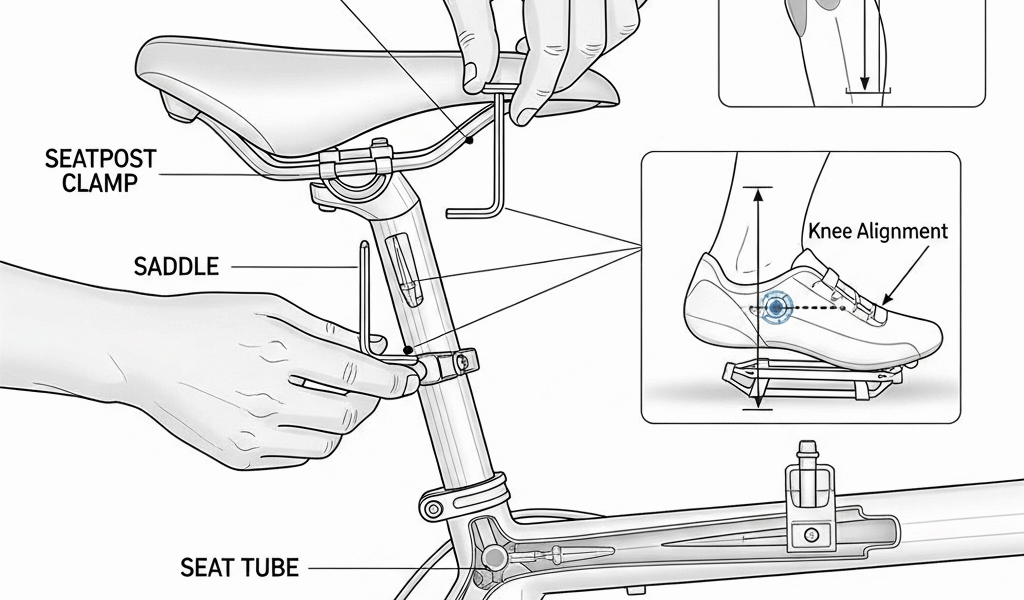
The target: roughly 30 degrees of knee bend when the pedal hits the 6 o’clock position. Here’s how to actually check it:
- Sit on your bike in your normal riding position.
- Drop one foot straight down to 6 o’clock.
- Your knee should form roughly a 30-degree angle — not locked out, not folded tight.
- If you’re sitting at 40 or 50 degrees, your saddle is too low. Probably by quite a bit.
I’m apparently an iPhone person and the free “Measure” app works for me while a physical goniometer never gave me consistent readings. Just point the phone at your knee. Takes maybe 90 seconds.
Raise the saddle 5mm. Ride for three to five days. Reassess. Your body needs time to settle into the new position before you go changing it again.
One detail that matters more than people think: use the right tool. Most saddle clamps use a 6mm Allen wrench — sometimes 5mm depending on the brand. Loosen the bolt maybe a quarter turn. Just enough to slide things. Don’t remove the bolt entirely. You’ll lose it. I lost one on a Sunday evening. It cost 40 cents to replace and required a special order from a shop that was closed until Tuesday.
If raising the saddle helps but doesn’t fully resolve things, the issue might be layered. Fore-aft saddle position and cleat alignment sometimes contribute to front knee pain too. But start with height. That’s the highest-leverage adjustment, and it’s free.
Fix Behind-the-Knee Pain — Lower Your Saddle
Pain behind the knee usually means your saddle is too high. Your leg overextends at the bottom of each stroke, and the tendons on the back of your thigh start sending angry messages.
This is, genuinely, the situation I’m dealing with right now. I raised my saddle too aggressively trying to fix front knee pain and overcorrected. Now my hamstring is tight and the back of my knee aches after rides longer than 45 minutes. Fun stuff.
When the saddle sits too high, your heel barely grazes the pedal at the bottom of the stroke. Your knee moves past that optimal 30-degree bend and edges toward hyperextension — stretching the hamstring tendon across the back of the joint. The popliteus muscle, a small muscle tucked behind the knee, takes the hit. Over time, tendinopathy develops. Not dangerous, but absolutely training-wrecking.
Lower your saddle. Same rules apply — 5mm at a time, three to five days between adjustments.
At the correct height, your heel should barely touch the pedal at the bottom of the stroke with a straight leg. Not straining to reach it. Not resting comfortably with space to spare. Barely. That margin is tighter than most people expect.
One thing worth mentioning: if you’re already running a pretty extended seat post — say, a 350mm post on a smaller frame — there’s a ceiling to how much lowering makes sense. But in most cases, dialing the height back down resolves posterior knee pain within two weeks. That’s been the consistent experience across everyone I’ve talked to who went through this.
Cleat Position Fixes for Side Knee Pain
Pain on the inside or outside of your knee? Saddle height probably isn’t your problem. Cleat rotation is.
Cleats are the metal pieces — Shimano SPD-SL, Look Keo, whatever system you’re running — that bolt to the bottom of your shoe and clip into the pedal. They seem like a minor detail. They are absolutely not a minor detail. Five degrees of rotation changes your entire knee tracking pattern through the pedal stroke.
If the cleat angles your toe too far inward, your knees cave inward on the downstroke. Too far outward, your knees flare out. Both create side-of-knee pain — inner or outer depending on which direction the cleat is pulling you.
Most road cleats — Look Keo Grey cleats, for example — offer about 4.5 degrees of rotational float. That gives your foot some freedom of movement. But float doesn’t compensate for a fundamentally wrong cleat angle. It just softens the damage a little.
Here’s how to check and adjust:
- Unclip and pull your shoes off the pedals.
- Look at the cleats from directly behind the shoe. They should align with your natural foot angle — most people stand with toes pointed slightly outward.
- If your toes are pointing sharply inward or dramatically outward, the cleats need rotation.
- Loosen the three cleat bolts — usually 3mm or 4mm Allen keys, depending on the shoe brand.
- Rotate the cleat slightly. We’re talking small fractions of a degree in practice.
- Retighten. Ride. Reassess.
I once knocked my shoe against a car door frame getting my bike out — rotated the cleat maybe three degrees by accident. That single incident caused two weeks of lateral knee pain before I figured out what happened. Three degrees. That’s how sensitive this is.
Also check fore-aft cleat position while you’re at it. The ball of your foot — that big metatarsal joint — should sit roughly over the pedal spindle. Too far forward or back changes pressure distribution across the foot and can generate side knee pain even if the rotation is perfect.
When to See a Bike Fitter vs a Doctor
Here’s the honest truth: most cycling knee pain gets better with bike fit adjustments. Not all of it. Most.
If you’ve moved your saddle 10 to 15 millimeters in either direction, given it two solid weeks of riding, and the pain has cleared up or nearly cleared up — you found your answer. Bike fit was the problem. Lock down the new position and stop touching things.
But if pain sticks around after two weeks of corrected setup, or if the pain arrived suddenly and sharply rather than building gradually over weeks, see someone. A physical therapist or sports medicine doctor can rule out patellar tendinitis, IT band syndrome, or cartilage damage — things that require actual medical treatment, not saddle adjustments.
A professional bike fit might be the best option, as persistent knee pain often requires a trained set of eyes to diagnose properly. That is because bike fit variables interact with each other in ways that are genuinely hard to self-diagnose — saddle height affects cleat position affects handlebar reach, all in a loop. A good fitter charges $150 to $400 for a full session. They’ll watch you ride, measure leg length, assess flexibility, and actually tell you what’s wrong. I wasted more than $400 on specialist copays before Marcus spent 90 minutes with me and solved it.
If you’re one or two weeks into knee pain, start with bike fit. Cheapest, fastest path to an answer. Pain building for several months? See a doctor first, rule out structural damage, then address the fit.
The order that works: adjust saddle height based on pain location, give it two weeks, escalate to a professional fitter if needed, escalate to a doctor if that fails. Follow that sequence and you’ll solve most cycling knee problems without spending a fortune figuring it out.


Stay in the loop
Get the latest cycle tech trends updates delivered to your inbox.