
Selle Italia has taken a bold step into the future of cycling comfort with the launch of their SLR Boost 3D range, a lineup of saddles that leverages additive manufacturing to deliver what the Italian brand claims is the most advanced seating technology available to cyclists today.
The Technology Behind SLR Boost 3D
At the heart of the SLR Boost 3D saddles lies Carbon Digital Light Synthesis (DLS) technology, a photochemical 3D printing process that creates an intricate lattice structure from liquid resin. Unlike traditional foam padding, this approach allows manufacturers to precisely control the density and support characteristics across different zones of the saddle.
The printing process works by projecting UV light through an oxygen-permeable window into a pool of UV-curable resin. The light selectively hardens the resin layer by layer, creating a complex three-dimensional structure that would be impossible to achieve through conventional manufacturing methods. The result is a lattice pattern that can be engineered to provide different levels of support and compliance in specific areas.
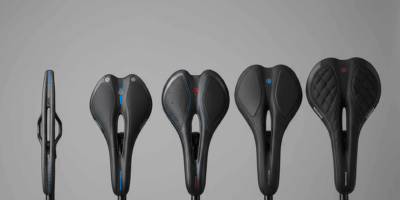
Selle Italia SLR Boost 3D Models
Selle Italia currently offers several variants in their 3D-printed lineup:
SLR Boost 3D Kit Carbonio Superflow: The flagship model features a carbon fiber shell combined with the 3D-printed lattice padding and high-tech carbon rails. The Superflow cutout design helps reduce pressure in the perineal area, addressing one of the most common complaints among serious cyclists.
SLR Boost 3D TI 316 Superflow: A more accessible option that pairs the same advanced 3D-printed padding with titanium 316 rails, offering a balance between performance and value at approximately 360 euros.
SLR 3D Carbon: Claiming to be the lightest 3D-printed saddle in the world at just 137 grams for the S3 size, this model uses an improved carbon rail angle for better vibration absorption while maintaining the differentiated cushioning zones that define the range.
The Customization Promise
While Selle Italia’s 3D saddles are not individually customized to each rider’s anatomy like some competitors offer, the technology enables more precise tuning of comfort zones than traditional manufacturing allows. The lattice structure features progressive absorption characteristics, meaning the material responds differently depending on the amount of pressure applied.
For riders seeking truly personalized saddles, companies like Posedla have taken 3D printing a step further. Using proprietary algorithms and multiple-angle imaging to create 3D models of riders’ sit bones, these custom solutions can produce saddles in 40 width options from 130mm to 170mm in precise 1mm increments. The stiffness is adjusted using a lattice density algorithm, creating softer zones in some areas and stiffer ones in others based on individual ride data.
Price Point and Value Analysis
The SLR Boost 3D Kit Carbonio Superflow retails around 400-450 euros, placing it in competition with similar offerings from Specialized and Fizik. This pricing reflects the premium nature of the technology, though it’s worth noting that all three major brands use Carbon’s DLS technology for their 3D-printed saddles, manufactured at the same California-based facility.
Compared to traditional high-end saddles in the 150-200 euro range, the premium for 3D-printed technology is substantial. However, advocates argue the improved comfort and reduced pressure points justify the investment, particularly for riders who spend many hours in the saddle or have struggled to find a comfortable fit with conventional options.
How 3D Saddles Compare to Traditional Options
Traditional saddles rely on foam padding of varying densities, sometimes combined with gel inserts, to provide cushioning. This approach has limitations in how precisely manufacturers can tune the support characteristics across the saddle surface. The density transitions tend to be gradual rather than precisely defined.
3D-printed lattice structures change this equation fundamentally. Each cell of the lattice can be designed with specific properties, creating distinct zones with sharp transitions between different support characteristics. The gyroid infill patterns used in modern 3D saddles allow for precise variation in density, optimizing support in key pressure zones while minimizing weight.
Weight savings are significant: the Selle Italia SLR 3D Carbon at 137 grams competes with the lightest traditional carbon saddles, while the CADEX Amp 3D reaches just 131 grams. The Fizik Adaptive 00 weighs 153 grams in its lightest version.
Other Brands in the 3D Printing Space
Specialized was an early pioneer with their Mirror technology, now available across the Power and Romin saddle lines. The S-Works Power with Mirror retails around 450 dollars, while the Power Pro with Mirror offers similar technology at 325 dollars with different rail materials.
Fizik’s Adaptive range has expanded to include models at various price points, from the Vento Argo R3 Adaptive at 260 dollars to the Antares Versus Evo 00 Adaptive at 400 dollars. Their One-to-One program offers truly custom saddles with GebioMized pressure mapping for 500-600 dollars.
Selle Italia also collaborates with ENVE on a co-branded version of the SLR Boost 3D Kit Carbonio Superflow, demonstrating the technology’s appeal to the premium component market.
The Future of Custom Bike Components
The success of 3D-printed saddles points toward a broader transformation in cycling component manufacturing. Titanium 3D-printed frames from companies like Bastion and Atherton Bikes have demonstrated the technology’s potential for creating custom geometries impossible with traditional tube-joining methods.
As printing technologies advance and costs decrease, we may see 3D printing expand into handlebars, stems, and potentially even more structural components. The ability to create rider-specific geometries and tune material properties zone by zone represents a fundamental shift from the mass-production paradigm that has dominated the industry.
For now, saddles remain the most practical application of the technology for most cyclists. The relatively small size keeps costs manageable while the direct impact on comfort makes the benefits immediately appreciable. Whether the Selle Italia SLR Boost 3D is worth the premium depends on individual needs, but there’s no question that additive manufacturing has permanently changed what’s possible in saddle design.



Stay in the loop
Get the latest cycle tech trends updates delivered to your inbox.